The SEO landscape is evolving rapidly with artificial intelligence at the forefront of this transformation. In 2026, AI-powered SEO tools have become essential for businesses and marketers looking to gain a competitive edge in search rankings. This comprehensive guide explores the best AI SEO tools available today, their key features, and how to leverage them effectively for your SEO strategy.
Quick Tip: When selecting AI SEO tools, prioritize those that offer transparent explanations of their recommendations. This helps you learn from the AI rather than blindly following suggestions.
Why AI SEO Tools Are Game-Changers in 2026
Traditional SEO tools provide data and insights, but AI SEO tools take it further by:
- Automating repetitive tasks that would take hours to complete manually
- Providing predictive analysis to anticipate algorithm changes and market trends
- Generating optimized content that satisfies both search engines and users
- Offering personalized recommendations based on your specific website data
- Scaling your SEO efforts without proportionally increasing workload
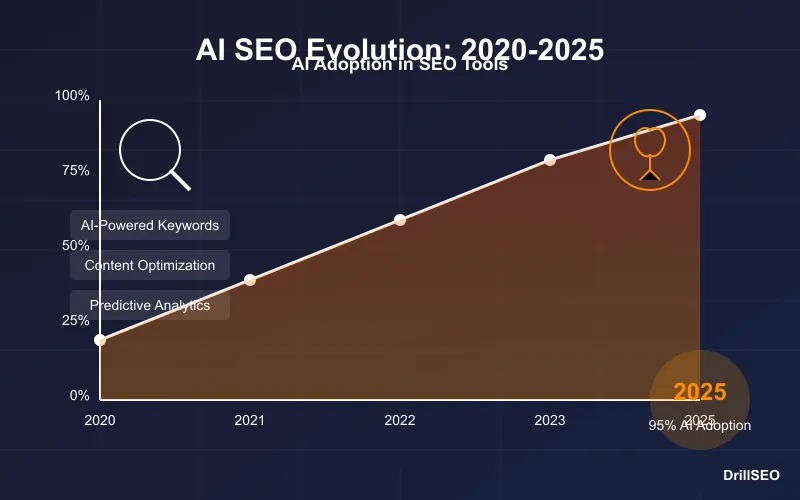
Categories of AI SEO Tools
1. AI-Powered Keyword Research Tools
Modern keyword research has evolved beyond simply finding high-volume terms. AI-powered keyword tools can now:
- Identify semantic relationships between keywords
- Predict keyword difficulty with greater accuracy
- Suggest content clusters based on user intent
- Forecast keyword trends before they appear in traditional tools
- Analyze search intent patterns across different markets and languages
// Example of AI-generated keyword clusters
Primary Keyword: "sustainable gardening"
Intent Clusters:
1. Educational: "sustainable gardening practices", "how to start sustainable garden"
2. Product-focused: "sustainable gardening tools", "eco-friendly garden supplies"
3. Problem-solving: "sustainable pest control", "water conservation gardening"
4. Local: "sustainable gardening [city]", "community gardens near me"
Top AI Keyword Research Tools for 2026:
- Semrush AI Writing Assistant - Combines keyword research with AI content optimization and now features intent-based keyword clustering
- Ahrefs' Keywords Explorer - Uses advanced machine learning for keyword difficulty prediction with 95% accuracy
- Clearscope - Provides AI-driven content optimization based on top-ranking pages with new NLP models
- Frase.io - Offers AI-powered topic research and content briefs with multilingual support
- MarketMuse - Uses AI to identify content gaps and opportunities with predictive ranking analysis
- KeywordInsight - New tool that specializes in identifying emerging keyword trends before they peak
2. AI Content Optimization and Creation Tools
Creating SEO-friendly content that also engages readers is a delicate balance. AI content tools have advanced significantly in 2026:
- Analyzing top-ranking content to identify patterns and success factors
- Suggesting optimal content structure and headings based on user engagement data
- Recommending related keywords and topics to cover for comprehensive content
- Evaluating readability and suggesting improvements for different audience segments
- Checking content for factual accuracy, completeness, and potential bias
- Generating entire first drafts that require minimal human editing
- Optimizing content for featured snippets and other SERP features
Content AI Ethics Note
When using AI content tools, always review outputs for accuracy and add your unique insights. Google's helpful content guidelines still prioritize content that demonstrates expertise, experience, and authenticity.
Leading AI Content Tools for 2026:
- Surfer SEO - Provides real-time content scoring with new AI models trained on 2026 ranking factors
- Jasper - Offers AI-powered content creation with SEO integration and factual grounding
- Neuron Writer - Uses semantic analysis for content optimization with E-E-A-T enhancement features
- Writesonic - Creates SEO-optimized content with AI that now includes multimedia suggestions
- Copymatic - Generates and optimizes various types of content with industry-specific training
- ContentScale - New platform that specializes in scaling content production while maintaining quality
- FactCheck AI - Specialized tool that verifies factual claims in your content
3. Technical SEO and Audit Tools with AI
Technical SEO remains crucial for rankings, and AI has made identifying and fixing issues much easier:
- Automatically detecting technical issues across your site with severity ratings
- Prioritizing fixes based on potential impact on rankings and user experience
- Providing actionable recommendations with step-by-step implementation guides
- Monitoring site health continuously with real-time alerts
- Predicting potential technical issues before they impact performance
- Automatically implementing fixes for common issues (with permission)
// Example of AI-prioritized technical issues
Critical (Fix immediately):
- 404 errors on high-traffic pages (Est. impact: -15% organic traffic)
- Core Web Vitals failures on mobile (Est. impact: -8% conversion rate)

High (Fix within 7 days):
- Duplicate content on category pages (Est. impact: keyword cannibalization)
- Missing schema markup on product pages (Est. impact: -30% CTR potential)

Medium (Fix within 30 days):
- Optimize image sizes (Est. impact: +2s page load improvement)
- Update outdated external links (Est. impact: minor trust signals)
Best AI-Enhanced Technical SEO Tools for 2026:
- Screaming Frog with AI Analysis - Traditional crawler now enhanced with advanced machine learning for issue prioritization
- Deepcrawl - Enterprise-level technical SEO with AI insights and automated fix implementation
- Botify - Uses AI to connect technical SEO issues with business impact and ROI calculations
- ContentKing - Real-time SEO auditing and monitoring with predictive alerts
- SE Ranking - Comprehensive SEO platform with AI-powered recommendations and competitive gap analysis
- TechSEO Boost - New specialized tool for JavaScript SEO issues and rendering optimization
4. AI Link Building and Outreach Tools
Link building remains one of the most challenging aspects of SEO. AI tools have revolutionized this area in 2026 by:
- Identifying high-quality link prospects automatically based on relevance and authority
- Personalizing outreach emails at scale with natural language generation
- Predicting link placement likelihood and potential impact on rankings
- Analyzing competitor backlink profiles for opportunities and weaknesses
- Monitoring link health and identifying toxic backlinks proactively
- Suggesting content ideas that naturally attract backlinks in your niche
Pro Tip: The most effective link building in 2026 combines AI outreach tools with genuine relationship building. Use AI to scale your efforts, but maintain authentic human connections with key partners.
Effective AI Link Building Tools for 2026:
- Pitchbox - AI-enhanced outreach and relationship management with new sentiment analysis features
- Link Whisper - Internal linking suggestions using advanced natural language processing and user behavior data
- BuzzStream - Relationship-based link building with AI assistance and opportunity scoring
- Hunter.io - Email finding with AI verification and response rate prediction
- Respona - Automated outreach with personalization that adapts based on recipient engagement
- LinkGraph - New tool that identifies link gaps compared to top-ranking competitors
- BacklinkIQ - Specialized in predicting which content will naturally earn backlinks
5. AI-Powered Analytics and Reporting
Understanding your SEO performance and extracting actionable insights is streamlined with AI analytics tools:
- Automatically identifying patterns and anomalies in traffic and engagement
- Providing natural language explanations of complex data trends
- Forecasting future performance based on current trends and seasonal factors
- Creating automated reports with key insights highlighted for different stakeholders
- Connecting SEO metrics directly to business outcomes and revenue
- Identifying correlations between on-site changes and performance shifts
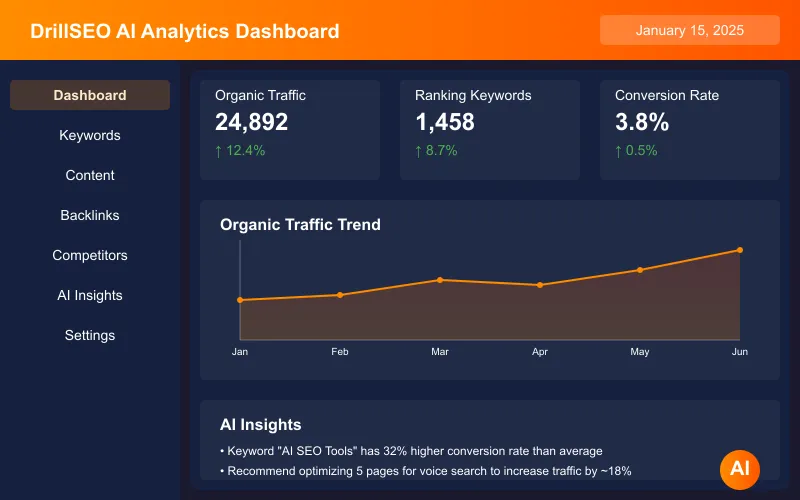
Top AI Analytics Tools for SEO in 2026:
- Google Analytics 4 - Built-in AI for predictive metrics and insights with enhanced attribution modeling
- Looker Studio - Advanced data visualization with AI-powered insights and automated narrative generation
- Similarweb - Market intelligence with AI-driven competitive analysis and opportunity identification
- Oribi - Event analytics with automated insights and customer journey mapping
- SEOmonitor - Forecasting and opportunity sizing with AI and business impact calculations
- InsightEngine - New tool specializing in connecting SEO metrics to revenue and ROI
How to Choose the Right AI SEO Tools for Your Needs
With so many options available, selecting the right AI SEO tools requires careful consideration:
- Assess your specific needs - Different businesses require different tools based on their size, industry, and goals
- Consider your technical expertise - Some AI tools require more technical knowledge than others
- Evaluate integration capabilities - Ensure the tools work well with your existing tech stack
- Check pricing structures - Many AI tools use tiered pricing based on usage
- Test before committing - Most tools offer free trials or demos
- Read user reviews - Learn from others' experiences with the tools
- Assess transparency - Choose tools that explain their recommendations rather than black-box solutions
- Consider data privacy - Ensure the tools comply with relevant regulations and protect your data
Tool Selection Framework
Create a scoring matrix for potential tools based on your priorities. Weight factors like ease of use, feature set, price, and support according to your team's specific needs.
Implementing AI SEO Tools: Best Practices for 2026
To maximize the benefits of AI SEO tools, follow these updated best practices:
- Start with clear objectives - Define what you want to achieve with AI SEO tools
- Implement gradually - Introduce one tool at a time to avoid overwhelming your team
- Provide proper training - Ensure your team knows how to use the tools effectively
- Combine AI with human expertise - Use AI as an assistant, not a replacement for human judgment
- Regularly review performance - Assess whether the tools are delivering the expected results
- Stay updated - AI SEO tools evolve rapidly; keep learning about new features
- Create feedback loops - Track which AI recommendations actually improve performance
- Develop an AI ethics policy - Establish guidelines for responsible AI use in your SEO strategy
// Sample AI SEO Implementation Timeline
Month 1: Implement AI keyword research tool + team training
Month 2: Add AI content optimization tool + establish workflow
Month 3: Integrate technical SEO AI + create issue resolution process
Month 4: Implement AI analytics + develop reporting templates
Month 5: Add AI link building tools + establish outreach protocols
Month 6: Full review of all tools + optimization of processes
The Future of AI in SEO: Beyond 2026
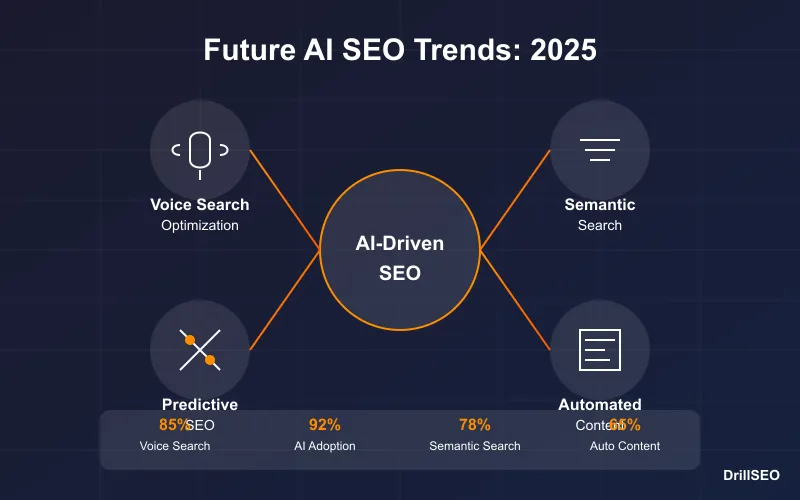
As we look beyond 2026, several emerging trends will shape the future of AI in SEO:
- Hyper-personalization - AI will enable more personalized search experiences tailored to individual user behavior patterns
- Predictive SEO - Tools will anticipate algorithm changes before they happen with increasing accuracy
- Multimodal optimization - AI will help optimize for voice, visual, and augmented reality search simultaneously
- Autonomous SEO - Some aspects of SEO will become fully automated with minimal human oversight
- Real-time adaptation - Tools that make changes based on immediate feedback and performance data
- Cross-platform optimization - Unified AI systems that optimize content across search, social, and emerging platforms
- Explainable AI - More transparent AI systems that clearly communicate the reasoning behind recommendations
Conclusion
AI SEO tools have transformed from novelties to necessities in 2026. By leveraging these powerful technologies, businesses can gain significant advantages in search visibility, efficiency, and ROI from their SEO efforts. The key is selecting the right tools for your specific needs and using them to enhance, rather than replace, human expertise.
As search engines continue to evolve with more sophisticated AI, using AI-powered tools for your SEO strategy isn't just an option—it's essential for staying competitive in the digital landscape. The most successful SEO strategies in 2026 combine the efficiency and scale of AI with the creativity, strategic thinking, and ethical judgment that only humans can provide.
Final Tip: Don't chase every new AI SEO tool that enters the market. Focus on building a core stack of reliable tools that work well together and address your specific business needs.
Related Articles
Frequently Asked Questions
Are AI SEO tools worth the investment?
Yes, for most businesses, AI SEO tools provide significant ROI by automating tasks, providing deeper insights, and helping achieve better rankings more efficiently than manual methods alone. In 2026, the competitive advantage they offer has become even more pronounced.
Can AI SEO tools replace human SEO specialists?
No, AI tools are best used to augment human expertise, not replace it. The most effective SEO strategies combine AI efficiency with human creativity, strategic thinking, and ethical judgment. Humans remain essential for understanding context, brand voice, and business goals.
How often are AI SEO tools updated?
Most reputable AI SEO tools update their algorithms and features regularly, often monthly or quarterly, to keep pace with search engine changes and improve their capabilities. In 2026, many tools now offer continuous learning that adapts to your specific data patterns.
Do I need technical knowledge to use AI SEO tools?
It depends on the tool. Many modern AI SEO tools are designed with user-friendly interfaces that require minimal technical knowledge, while others may need more expertise to utilize fully. The trend in 2026 is toward more accessible tools with natural language interfaces.
How can I measure the effectiveness of AI SEO tools?
Track key performance indicators like ranking improvements, organic traffic growth, time saved on tasks, and ultimately, conversion rates and ROI from organic search. The best AI tools now include built-in ROI tracking to demonstrate their value.
Are there privacy concerns with AI SEO tools?
Some AI SEO tools require access to your website data, analytics, and content to function effectively. Always review the privacy policies and data handling practices of any tool before implementation, and ensure they comply with relevant regulations like GDPR and CCPA.