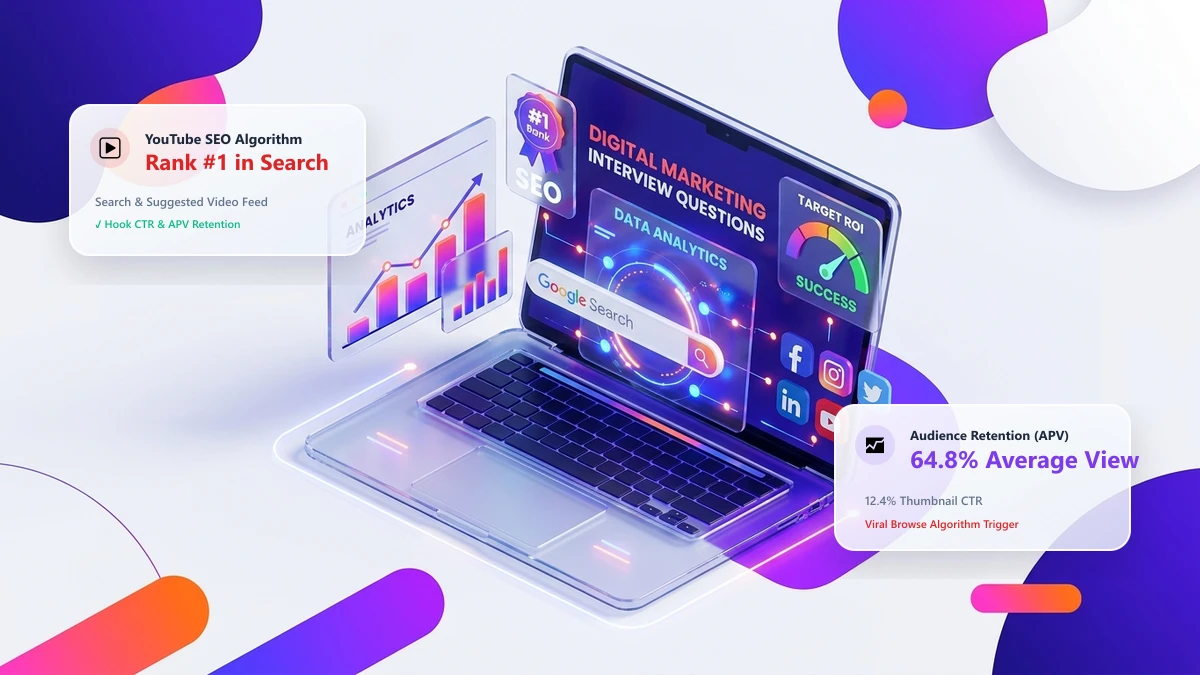
YouTube is not merely a social video network; it is the second largest search engine on the planet, processing over 3 billion searches every month. Yet more than 90% of uploaded videos languish with fewer than 100 views. Why? Because most creators treat YouTube optimization like traditional Google web SEO: stuffing keywords into tags and writing robotic descriptions while ignoring viewer behavioral psychology.
In 2026, YouTube’s recommendation neural networks (deep learning models built on Candidate Generation and Ranking) evaluate two distinct discovery systems: YouTube Search (utility intent) and Suggested / Browse Features (interest intent). In this comprehensive guide, you will learn the exact mechanics of YouTube’s ranking algorithm, how to maximize Click-Through Rate (CTR) and Average Percentage Viewed (APV), how spoken verbal transcripts index in search, and how to ignite exponential viral distribution.
1. The Dual Algorithmic System: Search vs. Suggested/Browse
YouTube does not have a single algorithm; it has multiple specialized machine learning models that cater to distinct viewer mindsets:
| Traffic Source | User Mindset | Primary Algorithm Objective | Key Optimization Focus |
|---|---|---|---|
| YouTube Search | Problem-solving & educational intent. The user types a query looking for an immediate answer or tutorial. | Deliver the most relevant, helpful, and comprehensive direct answer to the query. | Targeted keyword matching, timestamp chapters, spoken audio transcription, and initial CTR. |
| Suggested & Browse Features | Passive entertainment & discovery. The user is scrolling their homepage or watching related content. | Maximize cumulative session watch time by predicting what video the user will click next. | Emotionally provocative thumbnails, broad curiosity hooks, high Average Percentage Viewed (APV > 60%). |
The Strategic Growth Playbook: New channels must start by targeting Search (high-intent, evergreen “How-To” queries) to build initial audience trust and algorithmic confidence. Once YouTube establishes your channel’s core viewer profile, transition toward Suggested & Browse topics to scale into millions of views.
2. The 4 Decisive Ranking Factors in YouTube’s Algorithm
- Click-Through Rate (CTR): The percentage of impressions that turn into a video click. A CTR of 8% to 12%+ in the first 24 hours signals strong appeal, prompting YouTube to expand your impression reach across broader audiences.
- Average Percentage Viewed (APV / Retention): The percentage of the video watched. A 10-minute video with a 65% APV (6.5 minutes average duration) will vastly outperform a 20-minute video with a 20% APV (4 minutes average duration).
- Session Watch Time: Does watching your video keep the viewer on YouTube, or does it trigger an exit from the platform? Videos that lead to multi-video binge sessions receive an algorithmic boost.
- Viewer Satisfaction Signals: Post-view micro-surveys (“Did you enjoy this video?”), high like-to-view ratios, thoughtful long-form comments, and playlist saves.
3. High-CTR Title & Thumbnail Psychology
Your Title and Thumbnail represent 80% of your video’s success. If no one clicks, your video’s editing quality and insights do not matter.
The Complementary Thumbnail & Title Rule:
Never duplicate the title text inside the thumbnail. They must work together as a complementary one-two punch:
- The Thumbnail (The Visual Curiosity Hook): Use bold, expressive human facial reactions, high-contrast color palettes (yellow, red, neon cyan against dark backgrounds), and a maximum of 2 to 4 bold words that provoke an emotional question.
- The Title (The Contextual Promise): Front-load the primary search keyword while providing an irresistible payoff: e.g., “How to Rank #1 on Google in 2026 (Step-by-Step SEO Blueprint)”.
4. Audience Retention Engineering (The 30-Second Hook)
Over 50% of viewers abandon YouTube videos within the first 30 seconds. To eliminate drop-off dips in your retention graph:
- Eliminate the “Bumper Logo Intro”: Never open a video with an animated logo or 10 seconds of generic greeting. It causes an immediate 20% drop-off.
- The 5-Second Confirmation Hook: In the first 5 seconds, confirm immediately that the viewer is in the right place: “In this video, I am going to reveal the exact 5-step SEO framework that took our blog from 1,000 to 250,000 monthly visitors—and step 3 will surprise you.”
- Pattern Interrupts Every 45 Seconds: Re-engage the viewer’s visual attention using B-roll cutaways, on-screen text animations, zoom-ins, sound effects, and perspective shifts.
5. Metadata Optimization: Timestamps, Descriptions & Spoken Keywords
1. Spoken Audio Transcription (Automatic CC Indexing)
YouTube’s automated speech-to-text algorithm transcribes 100% of spoken audio in your video. Verbal keywords are actively indexed for search. Clearly speak your target primary and secondary keywords naturally during your intro and core sections.
2. Interactive Timestamps & Chapters
Include chronological timestamps in your video description. Not only do timestamps improve viewer satisfaction, but Google also indexes individual chapters as Key Moments directly in Google search results:
00:00 - Introduction & Core Problem
01:45 - The Dual YouTube Algorithm Explained
04:20 - Title & Thumbnail CTR Formula
07:15 - Audience Retention Retention Tactics
10:50 - Metadata & Chapter Optimization
13:30 - Final Checklist & Growth Flywheel
3. Description Architecture
The first 2 to 3 lines (above the “Show More” fold) carry the highest algorithmic weight. Write a compelling 2-sentence summary integrating your target keyword naturally, followed by links to mentioned resources and relevant cluster playlists.
6. How to Hack the “Suggested Videos” Sidebar Flywheel
To get your video recommended in the “Suggested Videos” sidebar beside a viral video in your niche:
- Identify the Top-Performing Anchor Video: Find an established viral video in your niche that consistently generates thousands of daily views.
- Match Semantic Metadata: Use similar core tags and category classification.
- Provide the “Next Logical Step”: Frame your video as the deeper solution or alternative perspective: e.g., if their video is “Top 10 Video Editing Tools”, your video should be “How to Edit a YouTube Video in 15 Minutes (Full Workflow)”.
- Audience Overlap Retention: When viewers click from their video to yours and watch for 5+ minutes, YouTube’s algorithm permanently binds the two videos together in recommendation carousels.
7. YouTube Shorts Algorithmic Synergy
YouTube Shorts operates on the swipe-based Shorts Feed, where the primary metric is Viewed vs. Swiped Away Rate (target >75%) and Completion Rate (>100% via looping).
Use Shorts as a rapid subscriber acquisition funnel: extract the most punchy 45-second insight from your long-form video, add dynamic captions, and use the native “Related Video” link sticker to drive mobile viewers directly into your full-length monetization asset.
8. Frequently Asked Questions (FAQs)
Q: Do YouTube video tags still matter in 2026?
A: Officially, YouTube states that video tags play a negligible role in rankings, serving primarily to catch common misspellings. Your title, spoken dialogue, thumbnail CTR, and watch time carry 95% of algorithmic weight.
Q: When is the best time to upload a video to YouTube?
A: Check YouTube Studio > Analytics > Audience > “When your viewers are on YouTube”. Publish your video 2 hours before your audience peak activity hours so the algorithm can process high-definition encoding, index closed captions, and notify initial subscribers.
Q: Can an older, dead video suddenly go viral?
A: Yes. YouTube regularly tests older videos against new audience segments. Updating an old video’s title and thumbnail with modern high-CTR graphics can revitalize impressions and trigger a massive recommendation wave months after publication.