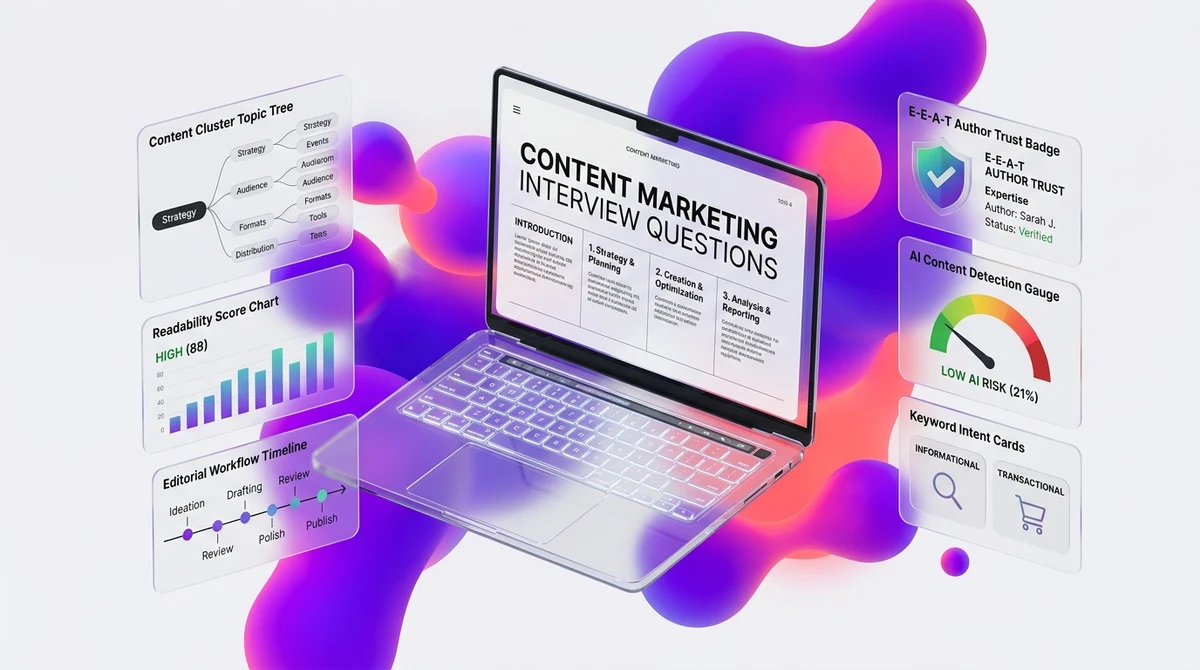
Content marketing in 2026 is no longer about pumping out 500-word keyword-stuffed blog posts or flooding the web with unvetted AI drafts. With Google’s Helpful Content System integrated into core algorithms, AI Overviews redefining search result layouts, and generative AI engines synthesizing answers directly, modern content marketers and SEO copywriters must operate as hybrid strategists: investigative journalists, data analysts, technical SEO practitioners, and conversion psychologists.
Whether you are interviewing for a Content Marketing Specialist, Senior SEO Copywriter, Content Strategist, or Head of Content role, interviewers want to test your ability to build predictable organic distribution engines, prove pipeline revenue contribution, and craft irreplacable human-first narratives with unshakeable E-E-A-T (Experience, Expertise, Authoritativeness, and Trustworthiness).
Part 1: Foundational Content Strategy & Search Architecture (Q1–Q10)
1. What is the fundamental difference between Content Marketing and Direct-Response Copywriting?
Answer: While both disciplines rely on compelling written communication, their objectives, time horizons, and psychological mechanisms differ fundamentally:
- Content Marketing: A long-term strategic approach focused on educating, entertaining, and building affinity with an audience by solving their informational pain points. The goal is to build brand equity, organic domain authority, and trust across all stages of the customer lifecycle (Top, Middle, and Bottom of the Funnel).
- Direct-Response Copywriting: Laser-focused on eliciting an immediate, measurable action (e.g., clicking a button, filling out a demo form, or completing an order). It employs behavioral triggers, scarcity, urgency, and objection handling on landing pages, sales letters, and promotional emails.
Modern content leaders bridge both: an educational guide provides 90% unselfish value, but utilizes strategic direct-response micro-copy (e.g., inline CTAs, value hooks, sticky navigation triggers) to guide warm readers into pipeline opportunities.
2. How do you design and execute a Topic Cluster model to capture semantic search dominance?
Answer: The topic cluster model moves beyond isolated keyword targeting to establish comprehensive topical authority. I structure clusters around three foundational pillars:
- Pillar Page: A comprehensive, high-level guide targeting a broad, high-volume parent keyword (e.g., “B2B SaaS Marketing”). It covers the entire subject broadly and introduces all core subtopics without exhausting micro-details.
- Cluster Content (Spokes): 8 to 20 deep-dive supporting articles that unpack specific long-tail queries and subtopics (e.g., “SaaS Churn Reduction Tactics”, “Product-Led Growth Metrics”, “SaaS Pricing Page Teardown”).
- Hyperlinked Architecture: Every supporting spoke links back to the pillar page using descriptive, target anchor text, and the pillar page links out to each spoke. Furthermore, sibling spokes cross-link to contextually relevant peers, creating an interconnected semantic web that signals complete topical coverage to Google’s semantic algorithms.
3. How do you align content creation with the Buyer’s Journey (TOFU, MOFU, BOFU)?
Answer: Content must map directly to intent stages, cognitive friction, and commercial proximity:
| Funnel Stage | Buyer Mindset | Primary Content Formats | Key Metrics |
|---|---|---|---|
| TOFU (Awareness) | Experiencing a problem; searching for symptoms, education, and concepts. | Educational blog posts, industry glossaries, infographics, trend reports. | Organic impressions, unique sessions, branded search lift. |
| MOFU (Consideration) | Evaluating solution categories; comparing methodologies and software stacks. | How-to teardowns, buyer templates, webinar playbooks, ROI calculators. | MQLs, newsletter opt-ins, content downloads, scroll depth. |
| BOFU (Decision) | Ready to purchase; comparing specific vendors, features, and pricing. | “Vs” comparison matrices, customer case studies, implementation guides. | Demo bookings, trial signups, pipeline velocity, closed-won ARR. |
4. How do you conduct a Content Gap Analysis to outrank established competitors?
Answer: A winning content gap analysis combines quantitative search data with qualitative editorial intelligence:
- Domain Keyword Gap: Using Ahrefs or Semrush, compare our root domain against 3–5 direct SERP competitors to surface keywords where they rank in positions 1–10 and we rank position 20+ or not at all.
- SERP Content Depth & Intent Audit: For each target cluster, examine the top 3 ranking URLs. Evaluate word count, media assets (custom diagrams vs. stock imagery), schema markup, fresh statistics, and unique angles.
- Information Gain & Perspective Deficit: Identify what all existing competitors missed. Do they regurgitate generic definitions? We inject original SME (Subject Matter Expert) quotes, real anonymized proprietary data, downloadable spreadsheets, and counter-intuitive industry insights to satisfy Google’s Information Gain patent.
5. How do you measure the ROI of top-of-funnel (TOFU) content that doesn't produce direct sales?
Answer: Measuring TOFU content purely by last-click attribution understates its commercial value. I measure TOFU ROI through a four-tiered framework:
- Multi-Touch Attribution Modeling: In GA4 or HubSpot, review linear, position-based, and data-driven attribution models to trace first-touch introduction paths of converted customers.
- Assisted Conversions: Track how many prospective buyers visited educational blog articles before later converting on a demo request via direct or branded search.
- Organic Equity & Link Acquisition: TOFU assets (e.g., industry statistics, original benchmarks) naturally attract authoritative editorial backlinks, boosting Domain Rating (DR) and lifting rankings for high-intent BOFU pages across the entire site.
- Paid Media Cost Savings: Calculate Organic Traffic Value—the equivalent spend required to buy that same search volume via Google Ads PPC.
6. What is your strategy for optimizing content for Google AI Overviews and LLM citations (Perplexity, SearchGPT)?
Answer: Optimizing for Generative Engine Optimization (GEO) requires structuring content so language models can easily extract and cite verified facts:
- Concise Inverted Pyramid Answers: Place a crisp, authoritative 40–60 word definition or answer immediately below the target H2 heading.
- Dense Structured Data: Use HTML bulleted lists, numbered step sequences, and comparative tables. LLMs favor structured formats when synthesizing direct responses.
- Entity-Rich Vocabulary: Reference recognizable industry entities, authoritative organizations, and standardized terminology defined in Wikidata.
- Original Data & Quotations: AI engines actively cite sources containing proprietary statistics, primary survey findings, and credited expert quotes that cannot be found elsewhere.
7. How do you determine true search intent when keyword tools report ambiguous volume?
Answer: Search volume tells you how many people query a phrase, but the live SERP reveals what Google has determined users actually want. I examine three SERP signals:
- SERP Feature Composition: Are there Video Carousels (informational/visual), Local 3-Packs (local navigational), Product Listing Ads (transactional), or People Also Ask accordions?
- Dominant Page Archetypes: Are the top 5 ranking results roundups/listicles, single product landing pages, calculators, or step-by-step technical documentation? If 8 out of 10 results are curated listicles, publishing an essay will fail regardless of backlink strength.
- Searcher Sub-Intent: Analyze the “People Also Ask” questions and related searches to identify the hidden doubts searchers need addressed before making a purchase decision.
8. How do you prevent content decay and maintain rankings for older legacy articles?
Answer: Content decay occurs when outdated information, stale dates, broken links, or new competitor assets cause rankings to decline. My quarterly content refresh workflow includes:
- Audit via Google Search Console: Identify URLs where impressions or average position have dropped 20%+ over the preceding 6 months.
- Data & Temporal Modernization: Update all statistics, screenshots, tool recommendations, and referenced year markers (e.g., 2026).
- SERP Gap Filling: Inspect newly ranking competitors to identify fresh subtopics or FAQ queries that emerged since the article was first published.
- Internal Link Injection: Add contextual internal links pointing from newly published articles to the refreshed asset, then request manual re-indexing in GSC.
9. How do you balance rigorous SEO keyword integration with an authentic brand voice?
Answer: SEO informs the structure, headings, and thematic coverage, but storytelling and brand voice drive engagement, retention, and conversion. I separate the process into two phases:
- Phase 1 (The Architectural Blueprint): Establish the H1, H2, and H3 outline based on semantic keyword research, user intent, and competitive gap analysis.
- Phase 2 (The Editorial Narrative): Draft the content using conversational, punchy syntax, relatable metaphors, and authentic industry terminology. Rather than awkwardly forcing exact-match phrases into sentences, I integrate keywords naturally where they flow conversationally, relying on Google’s natural language processing (NLP) to comprehend contextual synonyms.
10. What is your process for managing an Editorial Calendar across multiple stakeholders?
Answer: An effective editorial calendar is a pipeline workflow, not just a spreadsheet of topics. I organize calendars in tools like Notion, Asana, or ClickUp using a Kanban-style production board with strict stage gates:
Keyword Research & Brief Approved → SME Interview Scheduled → First Draft → Peer & SEO Review → Design/Graphics Integration → Staging & QA → Published → Distribution & Backlink Outreach
Each brief includes the primary and secondary keyword entities, target buyer persona, search intent stage, required word count, internal linking directives, and primary conversion goal.
Part 2: Advanced Copywriting Frameworks & E-E-A-T Execution (Q11–Q20)
11. How do you apply classic copywriting frameworks (AIDA, PAS, BAB, FAB) to organic blog posts?
Answer: Copywriting frameworks transform dry educational articles into emotionally compelling narratives that drive reader retention:
- PAS (Problem, Agitate, Solve): Ideal for intro hooks. State the user’s acute pain point immediately (Problem), demonstrate the catastrophic consequences of ignoring it (Agitate), and present this guide as the definitive blueprint (Solve).
- BAB (Before, After, Bridge): Perfect for case studies and tutorials. Paint the painful reality before the solution (Before), show the thriving outcome after implementation (After), and explain the exact step-by-step playbook that bridges the gap (Bridge).
- AIDA (Attention, Interest, Desire, Action): Best for long-form landing pages and mid-article lead generation magnets.
12. How do you demonstrate authentic E-E-A-T (Experience, Expertise, Authoritativeness, Trustworthiness) in written content?
Answer: With search engines heavily penalizing generic, unverified AI content, proving real-world experience is mandatory:
- Firsthand Experience (The Extra 'E'): Include original screenshots of software dashboards, actual trial-and-error anecdotes, personal test results, and original photographs rather than stock photography.
- Expert Bylines & Personas: Every article must feature an identifiable author with a verifiable bio, LinkedIn profile link, credentials, and industry experience.
- Citation of Primary Sources: Link directly to original research papers, peer-reviewed studies, or official documentation rather than third-party secondary summaries.
- Editorial Integrity: Provide clear publication dates, last updated timestamps, review badges (e.g., “Medically Reviewed by Dr. X” or “Fact Checked by Y”), and a transparent corrections policy.
13. What is your philosophy and workflow regarding generative AI (ChatGPT, Claude) in content production?
Answer: I view AI as an exceptional research assistant, ideation partner, and outline synthesizer, but a flawed final author. My operational rule is: “AI for velocity, humans for originality and soul.”
- Where AI Excels: Generating 20 headline variations, categorizing keyword lists, drafting basic Boolean search queries, summarizing lengthy transcripts, and identifying counter-arguments to address in briefs.
- Where AI Fails: Fact-checking accuracy, original journalistic storytelling, empathetic nuance, proprietary research, and unique brand voice. Every piece of published content must be drafted, fact-checked, and refined by human subject matter experts.
14. How do you optimize long-form content for high readability, user engagement, and scroll depth?
Answer: Searchers don’t read web pages word for word; they scan for immediate answers. I structure articles using the “greased chute” principle:
- The 1-2-3 Rule: Never exceed 3 to 4 sentences per paragraph. Break up dense walls of text with white space.
- Visual Landmarks: Insert styled callout boxes, pull quotes, bulleted takeaways, and responsive comparison tables every 300–400 words.
- Bucket Brigades: Use transition micro-phrases (e.g., “Here’s the kicker:”, “Why does this matter?”, “Let’s look at an example.”) to pull the reader down to the next sentence.
- Interactive Table of Contents: Provide sticky anchor links allowing users to jump directly to the exact subtopic they need.
15. How do you write high-CTR Title Tags and Meta Descriptions that avoid Google rewrite overrides?
Answer: Google rewrites more than 60% of meta titles when they are deemed truncated, uninformative, or mismatched with page content. To minimize rewrites while maximizing organic click-through rates (CTR):
- Length Guardrails: Keep titles between 50–58 characters (under 580 pixels) and meta descriptions between 140–155 characters.
- Front-Load Keywords: Place the primary high-intent keyword in the first 30 characters.
- Psychological Modifiers: Incorporate parenthetical qualifiers, fresh year markers, or bracketed hooks: e.g., “Top 40 Content Marketing Interview Questions (2026 Guide + Cheat Sheet)”.
- Active Voice & Value Proposition in Meta: Begin meta descriptions with action verbs and clarify the exact tangible payoff the reader receives by clicking.
16. How do you harvest Voice-of-Customer (VoC) data to sharpen your copywriting?
Answer: Great copy is not written from imagination; it is assembled from the customer’s own words. I collect VoC data through four primary channels:
- Sales & Customer Support Call Transcripts: Review Gong, Chorus, or Zendesk logs to extract the exact phrases, fears, and frustrations prospects express.
- Customer Review Scraping: Analyze G2, Capterra, Amazon, or Trustpilot reviews for both our product and top competitors. Pay close attention to 2- and 3-star reviews to pinpoint unmet needs.
- Community Listening: Mine relevant subreddits, Quora threads, and niche Slack/Discord communities for organic discussions on industry pain points.
- Exit-Intent Micro-Surveys: Run 1-question polls on high-traffic pages asking: “What information were you hoping to find today that we didn’t provide?”
17. How do you architect an internal linking strategy within a content marketing ecosystem?
Answer: Internal links are the nervous system of an SEO site. They pass PageRank equity and guide users along conversion pathways:
- Descriptive Anchor Text: Never use generic anchors like “click here” or “read more”. Use descriptive, semantically rich variations that reflect the target page’s core topic.
- Upstream & Downstream Linking: High-traffic TOFU articles must link downstream to commercial BOFU product/service pages. Simultaneously, BOFU pages should link to educational documentation to resolve technical objections.
- Contextual Relevance: Internal links placed in the first half of the body text pass more engagement value than footer or sidebar links.
18. What is the difference between B2B Thought Leadership and Programmatic SEO Copywriting?
Answer: They occupy opposite ends of the content spectrum:
- B2B Thought Leadership: High-touch, point-of-view driven content written by or ghostwritten for industry executives. It introduces proprietary hypotheses, challenges industry conventional wisdom, and targets C-suite decision-makers. Focuses on brand authority, press citations, and executive pipeline.
- Programmatic SEO Copywriting: Scaled, database-driven page generation targeting hundreds of thousands of low-competition, transactional long-tail variations (e.g., Zapier’s “Connect [App A] to [App B]” or Tripadvisor’s “Best Hotels in [City]”). Focuses on clean technical templates, dynamic schema, and automated data feeds.
19. How do you design compelling Lead Magnets that convert cold blog readers into qualified email subscribers?
Answer: The era of the generic “Sign up for our monthly newsletter” CTA is dead. High-converting lead magnets must offer immediate, consumable utility:
- Contextual Relevance: Offer a tailored resource specific to the article’s subtopic (e.g., an article on “SaaS Budgeting” offers a downloadable Excel CFO Budget Template, achieving a 12–18% opt-in rate vs. 1% for a generic newsletter pop-up).
- Frictionless Consumption: One-page cheat sheets, ready-to-use checklist spreadsheets, and copy-paste swipe files outperform dense 50-page whitepapers because prospects can implement them in under five minutes.
20. What editorial QA checklist do you run through before clicking “Publish” on an article?
Answer: My pre-publish QA checklist covers four distinct pillars:
- Editorial: Zero grammatical or syntax errors; tone aligns with brand style guide; all cited statistics verified against primary sources.
- SEO & Structure: Single H1 tag containing target keyword; clean H2/H3 semantic hierarchy; optimized URL slug (under 4 words); meta title and description configured; schema markup (Article, FAQ, Breadcrumb) validated.
- Visual & UX: Custom 1200x675 featured image compressed in WebP; all inline diagrams have descriptive
alttext; responsive formatting verified on mobile viewport. - Conversion & Tracking: At least 2 contextual inline CTAs with working UTM tracking parameters; all external links open in new tabs with appropriate
rel="noopener"attributes.
Part 3: Omnichannel Distribution & Asset Repurposing (Q21–Q30)
21. Explain the “Content Spoke” or “Content Repurposing Flywheel” methodology.
Answer: Publishing an article is only 20% of the battle; 80% of content success lies in systematic distribution. I use the 1-to-10 Repurposing Flywheel:
From one comprehensive 3,000-word pillar article, we systematically extract:
- 1 Executive LinkedIn Carousel: 6–8 slide PDF summarizing the core framework and key data charts.
- 2 High-Engagement X (Twitter) Threads: Unpacking the most controversial or counter-intuitive findings.
- 1 Dedicated Newsletter Edition: Distilling the primary thesis into a personal email with a direct link to the full post.
- 3 Short-Form Video Scripts: 60-second TikTok/Reels/YouTube Shorts delivering quick actionable tips.
- 1 Lead Magnet: Packaging the step-by-step checklist into a downloadable PDF for lead generation.
22. How do you collaborate with PR and Outreach teams to earn authoritative editorial backlinks?
Answer: Passive link building is dead. We create “Link Magnet” assets designed specifically to earn citations from journalists and bloggers:
- Original Industry Benchmarks & Surveys: Polling 300+ industry practitioners produces proprietary percentage metrics that journalists frequently cite when writing news stories.
- Curated Statistics Pages: Ranking for high-volume informational queries like “[Industry] Statistics 2026” passively earns dozens of high-DR backlinks every month from writers needing citations.
- Digital PR Pitches: Provide unique commentary and data summaries to journalists on platforms like Qwoted and Connectively (formerly HARO).
23. How do you build an email newsletter sequence that maintains 40%+ open rates?
Answer: Sustaining high newsletter engagement requires strict list hygiene and high editorial value:
- Deliverability Infrastructure: Ensure SPF, DKIM, DMARC, and BIMI records are authenticated. Regularly clean unengaged subscribers who haven't opened an email in 90 days.
- Curated Value Over Self-Promotion: Follow the 80/20 rule: 80% actionable industry insights, curated teardowns, and tactical advice; only 20% promotional pitches.
- Curiosity + Utility Subject Lines: Use short (under 40 characters), lowercase, conversational subject lines that sound like an email from a respected colleague.
24. How do you prevent duplicate content penalties when syndicating articles to Medium, Substack, or LinkedIn?
Answer: Cross-platform syndication expands reach without diluting search authority if executed properly:
- Cross-Domain Rel=Canonical: If the external platform supports it (like Medium), set the canonical URL pointing back to the original article on our root website.
- Delayed Syndication: Wait 7 to 14 days after original publication on our site until Google has fully crawled and indexed the original URL before syndicating externally.
- Partial Snippet with Backlink: Rather than syndicating 100% of the text on LinkedIn or Substack, publish the first 30% as a teaser and link directly back to the original blog for the full playbook.
25. How do you evaluate whether a topic should be an article, an interactive tool, or a video?
Answer: We evaluate the query’s operational intent and cognitive friction:
- Interactive Tool / Calculator: When the query involves mathematical computation, personal benchmarking, or financial estimates (e.g., “SaaS CAC Calculator” or “Email ROI Estimator”). Interactive tools capture 3x the backlinks and engagement of static text.
- Video Tutorial: When the topic requires visual software workflows, UI walkthroughs, or physical demonstration (e.g., “How to configure GA4 server-side tagging”).
- Written In-Depth Guide: When the query involves deep conceptual exploration, strategic frameworks, comparative analysis, or reference templates.
26. How do you leverage customer webinars, podcasts, and video transcripts for content engines?
Answer: Subject matter expert (SME) interviews are the gold standard for original content. We record 30-minute Zoom conversations with internal product engineers, customer success leaders, or external industry veterans, generate raw transcripts using AI transcription tools (Descript or Whisper), and then our editorial team extracts authentic quotes, customer case studies, and proprietary technical nuances that search competitors without access to internal SMEs cannot replicate.
27. What distribution metrics signal that a piece of content has achieved true “Product-Content Fit”?
Answer: When content resonates deeply, distribution becomes organic and compounding:
- High Unprompted Social Sharing: Readers voluntarily screenshot paragraphs or share URLs in private Slack/Discord communities and LinkedIn without being asked.
- Direct Referral Traffic: Sustained traffic originating from community forums, subreddits, and professional newsletters.
- High Organic Scroll Depth & Dwell Time: An average engagement time exceeding 3.5 minutes on a 2,500-word post.
- Inbound Backlinks Without Outreach: Independent bloggers and media outlets cite the article naturally in their own publications.
28. How do you build an audience through owned media versus rented media platforms?
Answer: Algorithms on rented platforms (LinkedIn, X, TikTok, YouTube) are volatile and subject to sudden reach compression. Rented media should serve as a discovery funnel to acquire owned media assets:
We use rented platforms to capture top-of-funnel attention, then systematically funnel those audiences into owned channels: an email subscriber base, an RSS feed, a private customer community, or direct bookmarks. Owned distribution ensures uninterrupted communication regardless of algorithmic changes.
29. How do you write B2B comparison pages (“Brand A vs. Brand B”) that remain credible while winning sales?
Answer: Biased, one-sided comparison pages destroy buyer trust. Winning comparison pages follow an objective evaluation model:
- Acknowledge Competitor Strengths: Explicitly state what the competitor does well (e.g., “Competitor X is fantastic for early-stage freelance solopreneurs seeking a free plan”).
- Define Your Ideal Customer Profile: Contrast this with your platform’s core advantage: “However, if you are a scaling enterprise needing SOC-2 compliance, advanced role-based permissions, and 24/7 dedicated engineering support, our platform was built for you.”
- Feature Matrix with Proof: Support every comparative claim with third-party verified ratings, customer testimonials, and screenshot evidence rather than vague marketing fluff.
30. How do you determine when a content campaign should be sunsetted or deprecated?
Answer: We review quarterly performance against predefined thresholds. A content initiative should be pruned or sunset if it meets three criteria: (1) zero search traffic or conversions for 12 consecutive months despite two targeted optimization refreshes, (2) the underlying product feature or industry concept is obsolete, and (3) redirecting (301) the URL to a more relevant, high-performing parent pillar consolidates topical equity without confusing historical visitors.
Part 4: Analytics, Revenue Attribution & High-Stakes Scenarios (Q31–Q40)
31. What metrics do you report to the C-suite versus what metrics you track in your daily editorial sprints?
Answer: Reporting must match executive priorities:
| Audience | Primary Focus | Key Metrics Tracked |
|---|---|---|
| C-Suite (CEO, CMO, CFO) | Commercial pipeline, revenue efficiency, CAC reduction. | Content-Attributed Pipeline ($ ARR), MQL-to-SQL Conversion Velocity, Customer Acquisition Cost (CAC), Organic Traffic Value ($). |
| Editorial & SEO Team | Content quality, production velocity, ranking progress. | Target Keyword Rankings (Positions 1–3 & 4–10), Organic Impressions, Engagement Rate, Scroll Depth, Word Count Efficiency, Publication Cadence. |
32. How do you interpret GA4 Engagement Rate, Scroll Depth, and Time on Page for content evaluation?
Answer: In GA4, Engagement Rate replaces the legacy Bounce Rate metric (a session is “engaged” if it lasts >10 seconds, has a conversion event, or views 2+ pages). However, for long-form editorial content, I look at engagement rate combined with custom scroll events (25%, 50%, 75%, 90% scroll milestones):
If an article has high average session duration (e.g., 4 minutes) but a low 90% scroll depth, readers are finding their answer quickly at the top of the page. If both engagement rate and scroll depth are low (<30%), it indicates a disconnect between searcher intent and the intro hook, signaling an immediate need for an editorial overhaul.
33. Scenario: A blog post receives 60,000 monthly visits but has a 0.04% conversion rate. How do you diagnose and fix it?
Answer: This is a classic “Traffic-Conversion Disconnect”. I execute a 4-step diagnostic:
- Intent Audit: Determine the search intent of the primary ranking keywords in GSC. If the post ranks for a broad informational definition query, visitors are not in a buying mindset.
- CTA Friction & Relevance Check: Are we pushing an aggressive, high-friction BOFU offer (like “Book a $10,000 Consultation Demo”) to a cold beginner? We must replace or supplement it with a low-friction MOFU lead magnet (e.g., a free downloadable template or checklist).
- Heatmap & Placement Analysis: Review Hotjar or Microsoft Clarity recordings to verify whether visitors ever reach the bottom CTA. Introduce sticky header CTAs or contextual inline banner callouts within the top 30% of the article.
- Offer Testing: Run an A/B test comparing an inline email capture form against a clickable interactive quiz or calculator.
34. Scenario: Organic traffic dropped 35% across your blog following a Google Core Update. What is your 30-day recovery plan?
Answer: Panic-editing during a live core update does more harm than good. My systematic recovery roadmap:
- Days 1–7 (Damage Assessment): Wait until the update rollout is officially complete. Export GSC data to identify exactly which URLs and keyword clusters lost positions. Categorize drops into sitewide sitewide algorithmic dampening vs. individual URL demotions.
- Days 8–15 (Competitive SERP Audit): Analyze the URLs that displaced us. Did Google shift intent toward forum discussions (Reddit/Quora), authoritative news outlets, or media-rich interactive guides?
- Days 16–25 (E-E-A-T & Content Pruning): Prune or consolidate low-quality, thin, or duplicate articles that dilute site authority. Inject verifiable author bios, primary data, and firsthand experience into impacted core articles.
- Days 26–30 (Technical & UX Polish): Verify Core Web Vitals, eliminate aggressive intrusive interstitial popups, and submit refreshed high-priority URLs for crawling.
35. Scenario: The sales team complains that incoming inbound leads generated by the blog are “unqualified and waste their time”. How do you resolve this?
Answer: This indicates an alignment issue between content targeting and the Ideal Customer Profile (ICP):
- Shadow Sales Calls: Sit in on 5–10 sales demo calls to understand why these leads are failing (e.g., lack of budget, solo freelancers when the product is built for 50+ employee enterprises).
- Filter via Form Fields: Introduce qualifying friction on lead capture forms (e.g., required business email address, company size dropdown, annual budget selection).
- Shift Content Mix Toward BOFU: Reduce output of generic beginner tutorials that attract students and hobbyists. Reallocate editorial bandwidth toward technical implementation teardowns, vendor migration guides, and enterprise compliance architectures that only qualified decision-makers read.
36. Scenario: The executive team asks to replace 50% of the freelance writing budget with fully automated AI content generators. How do you respond?
Answer: I respond with data, risk governance, and a strategic compromise:
I explain that while automated AI content is inexpensive upfront, publishing raw, unvetted AI content carries catastrophic long-term risks: algorithmic penalties under Google’s Helpful Content guidelines, hallucinated factual inaccuracies that damage brand credibility, and zero defensible differentiation against competitors using the exact same LLMs.
Instead, I propose a Hybrid AI-Human Efficiency Model: We equip our vetted freelance writers and editors with AI tools to accelerate research, outlining, and meta-data generation, reducing production time by 30–40%. We redirect those cost savings into proprietary SME interviews, custom data visualizations, and original research that build an unassailable organic moat.
37. How do you calculate Customer Acquisition Cost (CAC) and Lifetime Value (LTV) for content marketing?
Answer: The calculations must factor in total fully loaded investments:
Total Content Spend = Freelance/Staff Salaries + Software Subscriptions (Ahrefs, Clearscope, CMS) + Design & Link Assets
Content CPA = Total Content Spend / Total Direct & Assisted Conversions
Content LTV:CAC Ratio = (Average Customer Lifetime Value) / (Content-Attributed CAC)
A healthy content engine aims for an LTV:CAC ratio of 3:1 or higher within a 12-month payback window.
38. How do you recruit, onboard, and manage external freelance writers to ensure consistency?
Answer: High-performing freelance management requires rigorous systems:
- Niche SME Sourcing: Source writers through LinkedIn, industry niche publications, and specialized communities rather than low-cost generic content mills.
- The Living Editorial Style Guide: Provide a comprehensive onboarding manual defining tone of voice, formatting rules, capitalization, preferred sources, and banned clichés.
- Standardized Comprehensive Briefs: Every assignment includes a detailed brief with search intent, target entities, heading hierarchy, target word count, and required SME interview transcripts so writers never guess expectations.
39. What is your process for A/B testing headlines, calls-to-action (CTAs), and lead magnets?
Answer: Continuous conversion optimization compounds organic traffic value:
- Headlines & CTR: Test title tags using Google Search Console by establishing a 30-day baseline CTR, updating the title with a new hook, and measuring statistical CTR lift over the subsequent 30 days under comparable search impressions.
- On-Page CTAs: Use tools like VWO, Optimizely, or Google Tag Manager to test button color, copy framing (“Get Your Free Audit” vs. “Download The 2026 Checklist”), and form placements (in-line embedded form vs. slide-in modal).
40. Where do you see content marketing heading over the next 3 to 5 years with the rise of conversational AI search?
Answer: As conversational AI engines (SearchGPT, Perplexity, Gemini) answer basic factual queries zero-click, commoditized summary content will become virtually worthless. Winning content marketing in 2026 and beyond will be defined by three moats:
- Proprietary Data & Primary Research: Publishing original surveys, telemetry benchmarks, and lab experiments that AI models must cite as ground truth.
- Personality-Driven Thought Leadership: Authentic human perspective, contrarian viewpoints, and storytelling that builds direct brand affinity and community.
- Full-Funnel Interactive Utility: Providing software-like interactive tools, downloadable calculators, and customized assessments that conversational bots cannot replicate natively in text chat.
Strategic Comparison: Copywriting Frameworks in Practice
| Framework | Core Structure | Best Used For | Example Hook Headline |
|---|---|---|---|
| PAS | Problem → Agitate → Solution | B2B Blog intros, cold outreach emails, high-friction SaaS solutions. | “Tired of organic traffic drops every Google Core Update? Here is why your content is getting flagged—and the 5-step fix.” |
| BAB | Before → After → Bridge | Case studies, customer success stories, product launch pages. | “How DrillSEO transformed an early-stage blog from 500 monthly visitors to 250,000 organic sessions in 9 months.” |
| AIDA | Attention → Interest → Desire → Action | Landing pages, webinar signups, high-intent BOFU articles. | “Unlock our proprietary 2026 Content Audit Template used by Fortune 500 editorial teams to double pipeline velocity.” |
| FAB | Features → Advantages → Benefits | Product comparison teardowns, software feature updates. | “Automated internal linking: save 10 hours a week and pass 40% more PageRank equity across your cluster.” |
Frequently Asked Interview Questions & Preparation FAQs
Q: How do I prepare for a content marketing writing exercise or take-home assignment?
A: Focus on showcasing your end-to-end strategic process rather than just handing in a drafted blog post. Accompany your writing with a 1-page strategic memo detailing: target persona, search intent analysis, primary/secondary keyword entities, competitor content gaps you addressed, chosen headline variations with CTR rationale, and recommended distribution channels.
Q: How should I answer: “What is your favorite content marketing tool?”
A: Avoid naming just one generic tool. Present your specialized stack: Ahrefs/Semrush for keyword architecture and competitive gap audits, Clearscope/Surfer for semantic entity optimization, Hotjar/Clarity for behavioral reader heatmaps, and GA4/HubSpot for revenue attribution and conversion pipeline tracking.
Q: How can I stand out if I don’t have years of enterprise content experience?
A: Build a public proof of work. Launch a personal newsletter, publish deep-dive teardowns on LinkedIn, or conduct a live content audit of the company you are interviewing with. Showing up to the interview with a customized 90-day content gap teardown of their blog instantly separates you from 95% of candidates.