Understanding Preload Issues in WordPress
Resource preloading is a powerful technique that can significantly improve your WordPress site's loading speed by telling browsers to download critical resources earlier in the page load process. However, when implemented incorrectly, preloading can actually harm performance rather than help it.
In 2026, as Core Web Vitals continue to be crucial for SEO and user experience, properly handling preload directives has become more important than ever. This guide will help you identify and fix common preload issues in WordPress to ensure optimal performance.
What is Resource Preloading?
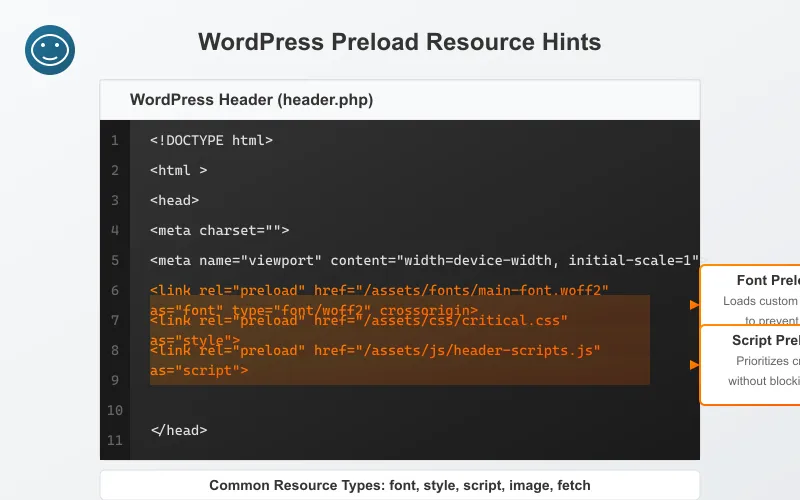
Resource preloading is a browser feature that allows you to declare fetch requests for certain resources before they're discovered naturally by the browser's HTML parser. This is done using the <link rel="preload"> directive in your HTML's <head> section.
When used correctly, preloading can:
- Reduce perceived loading time by prioritizing critical resources
- Improve Core Web Vitals metrics like Largest Contentful Paint (LCP)
- Prevent layout shifts by loading fonts earlier
- Optimize the loading of critical CSS and JavaScript
Common Preload Issues in WordPress
Despite its benefits, preloading can cause several issues when not implemented correctly. Here are the most common preload problems in WordPress sites:
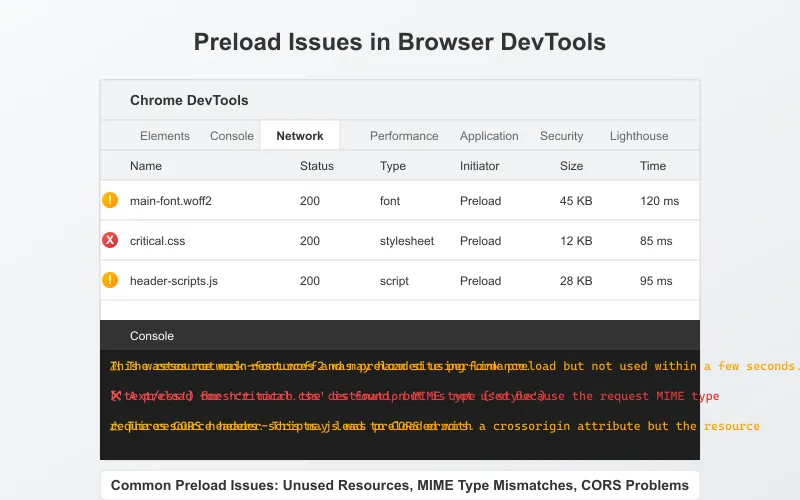
1. Unused Preloaded Resources
This occurs when you preload a resource that isn't actually used within a few seconds of the page load. The browser will download the resource, wasting bandwidth and potentially slowing down more important resources.
Common error message: "The resource [URL] was preloaded using link preload but not used within a few seconds"
2. Incorrect MIME Type Specification
Each preloaded resource must have the correct as attribute that matches its MIME type. If there's a mismatch, the browser may not use the preloaded resource, resulting in duplicate downloads.
Common error message: "A preload for '[URL]' is found, but is not used because the request MIME type ('[actual-type]') doesn't match the destination MIME type ('[expected-type]')"
3. Missing Crossorigin Attribute
When preloading fonts or other cross-origin resources, you must include the crossorigin attribute. Without it, the browser will download the resource twice.
Common error message: "The resource [URL] was preloaded with a crossorigin attribute but the resource requires CORS headers"
4. Too Many Preloaded Resources
Preloading too many resources can overwhelm the browser and actually slow down your page. Each preloaded resource competes for bandwidth and browser attention.
5. Preloading Low-Priority Resources
Preloading resources that aren't critical for the initial viewport can delay more important resources and harm performance.
Pro Tip: Use browser DevTools to identify preload issues. Open Chrome DevTools, go to the Network tab, and look for warnings in the Console tab. You can also use tools like Lighthouse or PageSpeed Insights to detect preload-related performance issues.
How to Fix Preload Issues in WordPress
Now that we understand the common preload issues, let's look at how to fix them in WordPress:
Solution 1: Audit and Remove Unnecessary Preloads
The first step is to identify and remove any unnecessary preloads:
- Open Chrome DevTools (F12 or Right-click → Inspect)
- Go to the Network tab and reload your page
- Check the Console tab for preload warnings
- Identify resources that are being preloaded but not used
Once identified, you can remove these preloads from your theme or plugin. They might be located in:
- Your theme's
header.phpfile - A performance plugin's settings
- Custom code added to the
<head>section
Solution 2: Fix MIME Type Mismatches
Ensure each preloaded resource has the correct as attribute:
<!-- For CSS files -->
<link rel="preload" href="/path/to/style.css" as="style">

<!-- For JavaScript files -->
<link rel="preload" href="/path/to/script.js" as="script">

<!-- For fonts -->
<link rel="preload" href="/path/to/font.woff2" as="font" type="font/woff2" crossorigin>

<!-- For images -->
<link rel="preload" href="/path/to/image.webp" as="image" type="image/webp">
Solution 3: Add Crossorigin Attribute for Fonts and Cross-Origin Resources
Always add the crossorigin attribute when preloading fonts or any resources from a different domain:
<link rel="preload" href="/path/to/font.woff2" as="font" type="font/woff2" crossorigin>
<link rel="preload" href="https://external-domain.com/resource.js" as="script" crossorigin>
Solution 4: Implement Preloads in WordPress Using Code
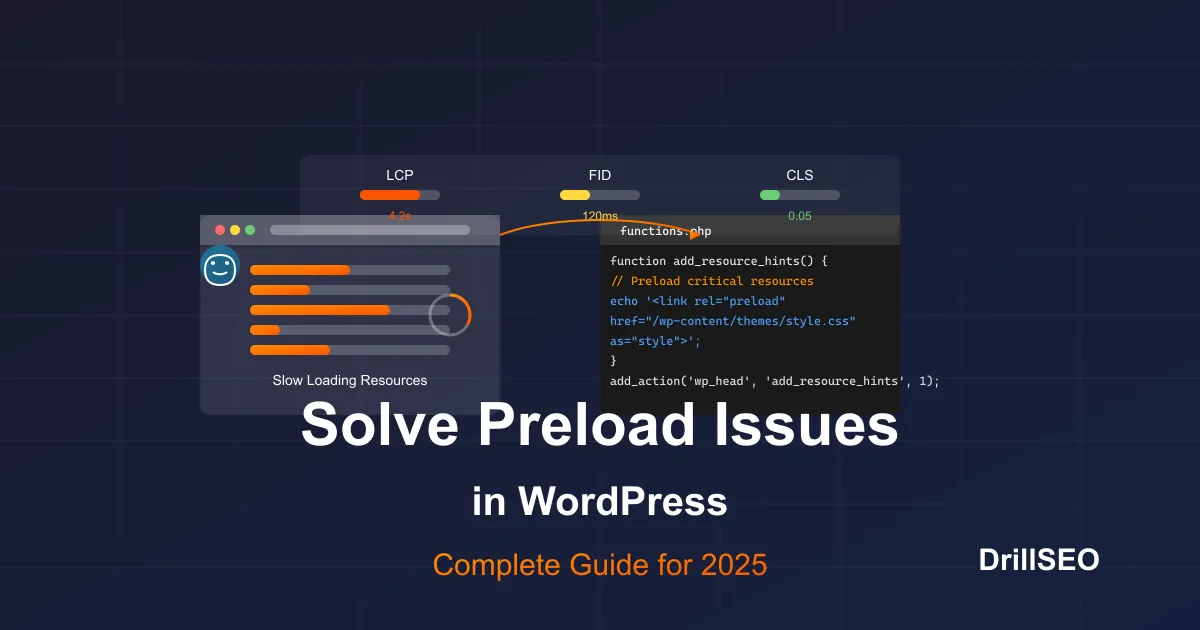
To properly implement preloads in WordPress, you can add the following code to your theme's functions.php file:
function add_resource_hints() {
    // Preload critical CSS
    echo '<link rel="preload" href="' . get_template_directory_uri() . '/assets/css/critical.css" as="style">';

    // Preload main font
    echo '<link rel="preload" href="' . get_template_directory_uri() . '/assets/fonts/main-font.woff2" as="font" type="font/woff2" crossorigin>';

    // Preload critical JavaScript
    echo '<link rel="preload" href="' . get_template_directory_uri() . '/assets/js/critical.js" as="script">';

    // Preload hero image (only if it's above the fold)
    if (is_front_page()) {
        echo '<link rel="preload" href="' . get_template_directory_uri() . '/assets/images/hero.webp" as="image" type="image/webp">';
    }
}
add_action('wp_head', 'add_resource_hints', 1);
Important: Only preload resources that are critical for the initial viewport. Typically, this includes your main CSS file, primary font, and any JavaScript required for above-the-fold content.
Solution 5: Use a Caching Plugin with Preload Controls
Several WordPress caching plugins offer preload functionality with proper controls:
WP Rocket
- Go to WP Rocket → Settings
- Navigate to the "File Optimization" tab
- Find the "Preload" section
- Carefully select only critical resources to preload
- Save changes
LiteSpeed Cache
- Go to LiteSpeed Cache → Optimization
- Find the "CSS/JS Optimization" section
- Configure "CSS Preload" and "JS Preload" options
- Only enable for critical resources
- Save changes
W3 Total Cache
- Go to Performance → Minify
- Find the "HTML & XML" section
- Add your critical resources to the "Preload" field
- Save all settings
Advanced Preloading Techniques for 2026
As browsers and web standards evolve, more advanced preloading techniques have become available:
Technique 1: Preload with Priority Hints
In 2026, most modern browsers support priority hints, which allow you to specify the importance of preloaded resources:
<link rel="preload" href="/critical.css" as="style" fetchpriority="high">
<link rel="preload" href="/less-important.js" as="script" fetchpriority="low">
Technique 2: Conditional Preloading
Implement conditional logic to only preload resources when they're needed:
function conditional_preloads() {
    // Only preload slider script on the homepage
    if (is_front_page()) {
        echo '<link rel="preload" href="' . get_template_directory_uri() . '/assets/js/slider.js" as="script">';
    }

    // Only preload comment script on single posts
    if (is_single()) {
        echo '<link rel="preload" href="' . get_template_directory_uri() . '/assets/js/comments.js" as="script">';
    }
}
add_action('wp_head', 'conditional_preloads', 1);
Technique 3: Preload Critical-CSS
Extract and preload only the CSS needed for above-the-fold content:
<!-- In your header.php file -->
<link rel="preload" href="<?php echo get_template_directory_uri(); ?>/assets/css/critical.css" as="style">
<link rel="stylesheet" href="<?php echo get_template_directory_uri(); ?>/assets/css/critical.css">

<!-- Load non-critical CSS with lower priority -->
<link rel="preload" href="<?php echo get_template_directory_uri(); ?>/style.css" as="style" onload="this.onload=null;this.rel='stylesheet'">
<noscript><link rel="stylesheet" href="<?php echo get_template_directory_uri(); ?>/style.css"></noscript>
Measuring the Impact of Preload Optimizations
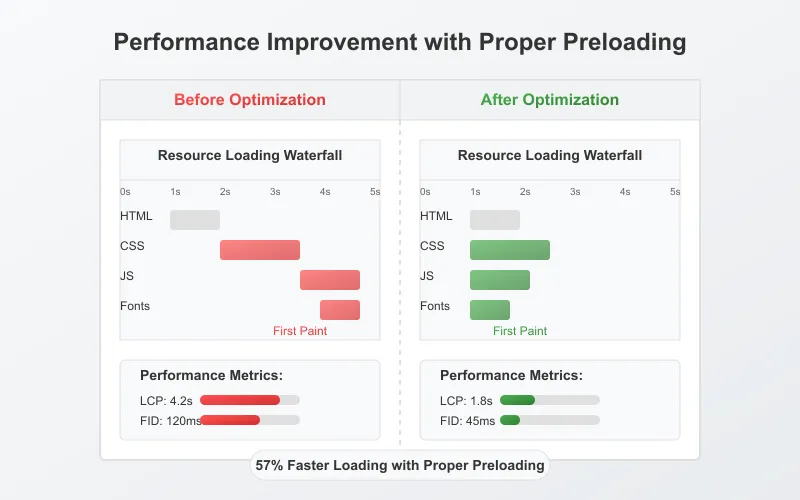
After implementing these fixes, it's important to measure their impact:
Tools to Measure Performance
- Google PageSpeed Insights: Provides Core Web Vitals metrics and identifies preload issues
- Chrome DevTools: Use the Network and Performance tabs to analyze resource loading
- WebPageTest: Offers detailed waterfall charts to visualize resource loading sequence
- Lighthouse: Built into Chrome DevTools, provides performance scores and suggestions
Key Metrics to Monitor
- Largest Contentful Paint (LCP): Should be under 2.5 seconds
- First Input Delay (FID): Should be under 100ms
- Cumulative Layout Shift (CLS): Should be under 0.1
- Time to First Byte (TTFB): Should be under 800ms
- Total Blocking Time (TBT): Should be minimized
Preload Best Practices for WordPress in 2026
To ensure optimal performance with preloading, follow these best practices:
1. Be Selective
Only preload resources that are:
- Critical for the initial viewport
- Not easily discoverable by the browser's HTML parser
- Needed early in the page load process
2. Prioritize Correctly
Preload resources in this order of importance:
- Critical CSS
- Web fonts used above the fold
- Critical JavaScript
- Hero images
3. Test on Multiple Devices
What's critical on desktop might not be critical on mobile. Test your preload strategy on various devices and connection speeds.
4. Regularly Audit Preloads
As your site evolves, regularly check for unused or unnecessary preloads using browser DevTools.
5. Consider Using Resource Hints
In addition to preload, consider using other resource hints:
preconnect: Establish early connections to important third-party domainsdns-prefetch: Resolve DNS for domains you'll connect to laterprefetch: Low-priority fetch for resources needed for future navigations
<!-- Preconnect to Google Fonts -->
<link rel="preconnect" href="https://fonts.googleapis.com">
<link rel="preconnect" href="https://fonts.gstatic.com" crossorigin>

<!-- DNS prefetch for analytics -->
<link rel="dns-prefetch" href="https://www.google-analytics.com">

<!-- Prefetch for next page in user flow -->
<link rel="prefetch" href="/likely-next-page/">
Conclusion
Properly implementing resource preloading in WordPress can significantly improve your site's performance and user experience. By understanding common preload issues and applying the solutions outlined in this guide, you can ensure your WordPress site loads faster and ranks better in search results.
Remember that preloading is just one aspect of web performance optimization. For the best results, combine proper preloading with other performance best practices like image optimization, efficient caching, and minimizing render-blocking resources.
Frequently Asked Questions
How many resources should I preload on my WordPress site?
As a general rule, limit preloading to 3-5 critical resources. Preloading too many resources can overwhelm the browser and actually harm performance. Focus on your main CSS file, primary font, and any critical JavaScript needed for above-the-fold content.
Do I need to preload images in WordPress?
Only preload images that are part of the initial viewport (above the fold) and contribute to the Largest Contentful Paint (LCP). Hero images on your homepage are good candidates for preloading. Don't preload images that appear below the fold.
Can preloading hurt my WordPress site's performance?
Yes, improper preloading can harm performance by wasting bandwidth, creating resource contention, and potentially delaying more important resources. Always test before and after implementing preloads to ensure they're actually improving performance.
Should I preload Google Fonts in WordPress?
If you're using Google Fonts and they're critical to your site's appearance, preloading the font files can help prevent layout shifts and improve the user experience. Make sure to include the crossorigin attribute when preloading fonts.
How do I know if my preload implementation is working correctly?
Use Chrome DevTools to check for preload-related warnings in the Console tab. Also, compare performance metrics before and after implementing preloads using tools like PageSpeed Insights or WebPageTest. You should see improvements in metrics like Largest Contentful Paint (LCP) if your preload strategy is effective.