What is a Favicon and Why is it Important for Your Blogger Site?
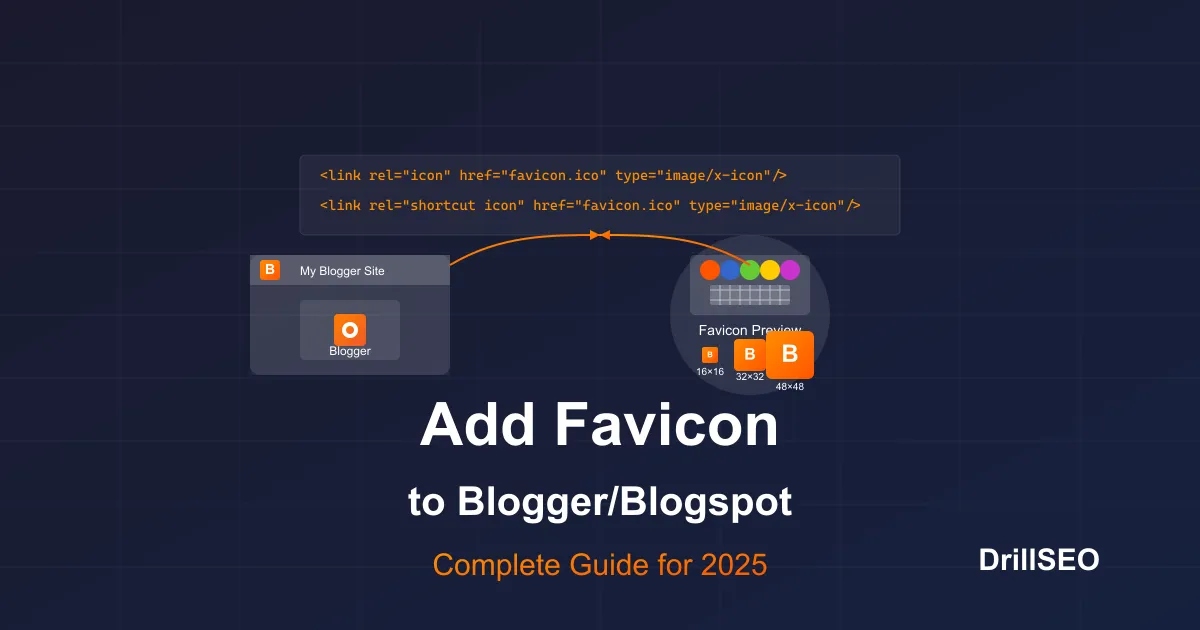
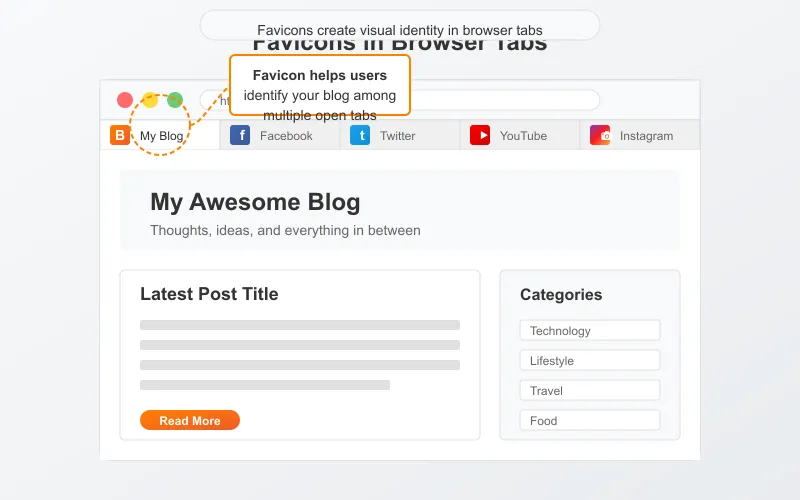
A favicon (short for "favorite icon") is a small, square image that appears next to your website's name in browser tabs, bookmarks, and history. For Blogger/Blogspot sites, adding a favicon is an essential branding element that helps your blog stand out and appear more professional.
In 2026, favicons have become even more important as they:
- Improve brand recognition and recall
- Make your site look more professional and trustworthy
- Help users quickly identify your site among multiple open tabs
- Enhance the user experience across devices
- Contribute to your site's overall visual identity
Favicon Requirements and Best Practices in 2026
Before we dive into the implementation, let's understand the current requirements and best practices for favicons:
Size and Format
- Recommended size: 32×32 pixels (minimum), with 48×48 or 64×64 pixels being ideal for modern displays
- Best formats: ICO, PNG, SVG, or WebP (WebP is now widely supported and offers better compression)
- File size: Keep under 100KB for optimal loading speed
Design Tips
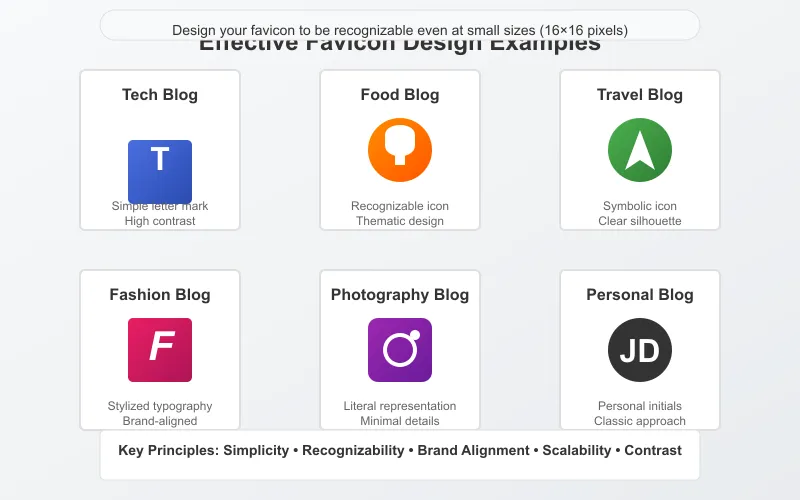
- Use a simplified version of your logo that's recognizable at small sizes
- Ensure good contrast so your favicon is visible against both light and dark browser themes
- Avoid text unless it's part of your logo and clearly legible at small sizes
- Test your favicon against different colored backgrounds
Pro Tip: Create a favicon that works well at multiple sizes. Modern browsers and devices may display your favicon at various dimensions, from tiny 16×16 pixels up to 192×192 pixels for some mobile devices.
3 Methods to Add a Favicon to Blogger/Blogspot
There are three main methods to add a favicon to your Blogger site in 2026. We'll cover each one in detail, from the simplest to the most customizable:
Method 1: Using Blogger's Built-in Favicon Option (Easiest)
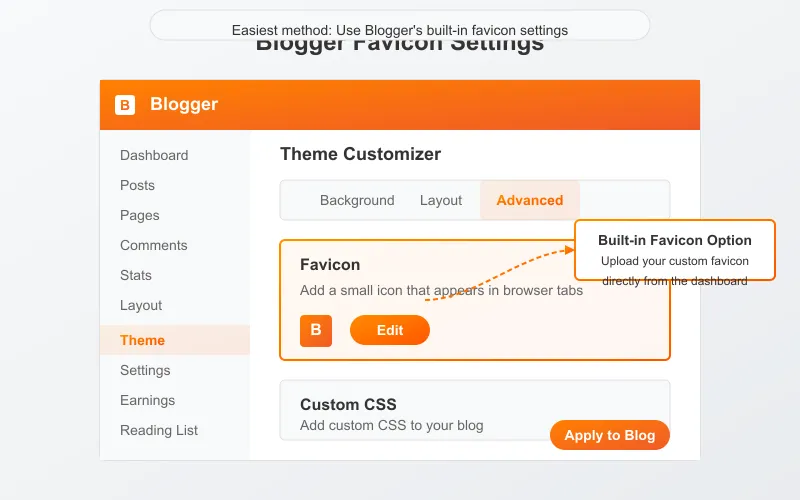
Blogger now includes a built-in option to add a favicon directly from the dashboard. This is the simplest method and works well for most users:
- Log in to your Blogger account
- Click on "Theme" in the left sidebar
- Click the "Customize" button
- In the theme customizer, click on "Advanced"
- Scroll down and find "Favicon"
- Click "Edit" and then upload your favicon image
- Click "Apply to Blog" to save your changes
Note: If you don't see the favicon option in your theme customizer, your theme might not support this feature. In that case, use Method 2 or 3 instead.
Method 2: Using HTML/CSS in the Theme Editor
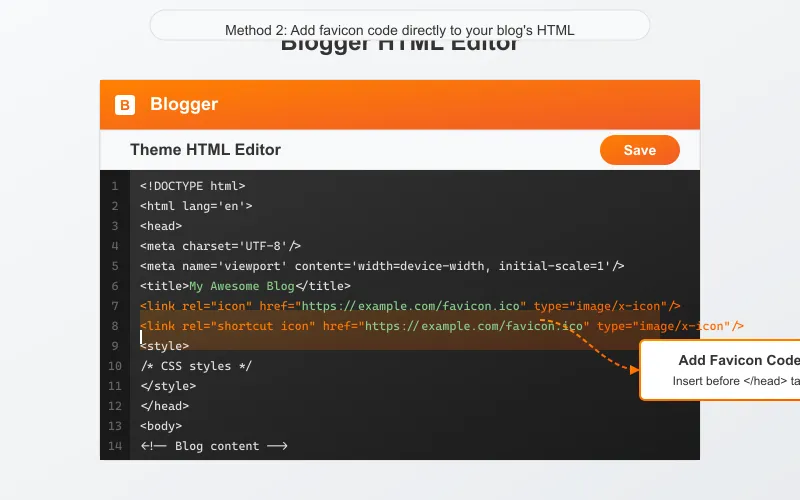
If your theme doesn't support the built-in favicon option or you want more control, you can add the favicon code directly to your blog's HTML:
- First, upload your favicon image to a hosting service like ImgBB or PostImages
- Copy the direct URL to your uploaded favicon
- Log in to your Blogger account
- Click on "Theme" in the left sidebar
- Click the "Edit HTML" button (three dots icon → "Edit HTML")
- Find the
<head>section in your theme's HTML - Add the following code just before the
</head>tag, replacing "YOUR_FAVICON_URL" with the actual URL of your favicon:
<link rel="icon" href="YOUR_FAVICON_URL" type="image/x-icon"/>
<link rel="shortcut icon" href="YOUR_FAVICON_URL" type="image/x-icon"/>
For WebP format (recommended in 2026):
<link rel="icon" href="YOUR_FAVICON_URL" type="image/webp"/>
<link rel="shortcut icon" href="YOUR_FAVICON_URL" type="image/webp"/>
For SVG format (scalable and modern):
<link rel="icon" href="YOUR_FAVICON_URL" type="image/svg+xml"/>
- Click "Save" to apply your changes
Method 3: Using a Comprehensive Favicon Solution (Advanced)
For the most comprehensive favicon support across all devices and browsers in 2026, you can implement a complete favicon solution:
- Create multiple favicon sizes using a tool like Real Favicon Generator or DrillSEO Favicon Generator
- Upload all generated favicon files to an image hosting service
- Log in to your Blogger account
- Click on "Theme" in the left sidebar
- Click the "Edit HTML" button
- Find the
<head>section in your theme's HTML - Add the following comprehensive code just before the
</head>tag, replacing all instances of "YOUR_FAVICON_URL" with the actual URLs of your favicon files:
<!-- Standard favicon -->
<link rel="icon" href="YOUR_FAVICON_URL.ico" sizes="any">
<link rel="icon" href="YOUR_FAVICON_URL.svg" type="image/svg+xml">
<link rel="icon" href="YOUR_FAVICON_URL_32x32.png" sizes="32x32" type="image/png">
<link rel="icon" href="YOUR_FAVICON_URL_16x16.png" sizes="16x16" type="image/png">

<!-- Apple Touch Icon (for iOS devices) -->
<link rel="apple-touch-icon" href="YOUR_FAVICON_URL_180x180.png" sizes="180x180">

<!-- Android Chrome -->
<link rel="manifest" href="YOUR_MANIFEST_URL.webmanifest">
<meta name="theme-color" content="#ffffff">

<!-- Microsoft Tiles (for Windows) -->
<meta name="msapplication-TileColor" content="#ffffff">
<meta name="msapplication-TileImage" content="YOUR_FAVICON_URL_144x144.png">
- Click "Save" to apply your changes
Pro Tip: If you use the Real Favicon Generator tool, it will create all the necessary files and provide you with the exact code to paste into your blog's HTML.
Creating an Effective Favicon for Your Blogger Site
If you don't already have a favicon, here's how to create one that effectively represents your brand:
Option 1: Use Online Favicon Generators
Several free online tools can help you create a favicon quickly:
- DrillSEO Favicon Generator - Our free tool that creates optimized favicons
- Favicon.io - Create favicons from text, images, or emojis
- Canva - Design a logo that can be exported as a favicon
Option 2: Use Graphic Design Software
For more control over your favicon design:
- Adobe Photoshop or Illustrator: Professional tools for creating pixel-perfect icons
- GIMP: A free alternative to Photoshop with similar capabilities
- Inkscape: A free vector graphics editor, ideal for creating SVG favicons
Design Principles for Effective Favicons
- Simplicity: Avoid complex designs that become unrecognizable at small sizes
- Consistency: Your favicon should align with your overall brand identity
- Distinctiveness: Create something unique that stands out from other sites
- Scalability: Ensure your design works well at different sizes
- Color: Use colors that reflect your brand and provide good contrast
Troubleshooting Favicon Issues on Blogger
If your favicon isn't appearing after following the steps above, try these troubleshooting tips:
Favicon Not Showing Up
- Clear your browser cache: Browsers often cache favicons, so changes may not appear immediately
- Check file format compatibility: Ensure your favicon is in a widely supported format (ICO, PNG, SVG, or WebP)
- Verify the URL: Make sure the URL to your favicon is correct and accessible
- Check for HTML errors: Ensure your favicon code is properly formatted and placed in the
<head>section - Try a different browser: Test your site in multiple browsers to see if the issue is browser-specific
Favicon Appears Distorted
- Check image dimensions: Ensure your favicon is a perfect square (e.g., 32×32, 48×48, 64×64)
- Verify image quality: Make sure your favicon isn't blurry or pixelated at its original size
- Simplify the design: If your favicon looks cluttered at small sizes, simplify it
Note: Some Blogger themes may override your favicon settings. If you're using a custom theme, check if it has its own favicon implementation that might be conflicting with yours.
Advanced Favicon Features for Blogger Sites in 2026
To take your Blogger favicon to the next level, consider these advanced features:
Animated Favicons
Animated favicons can add a dynamic element to your site's presence in browser tabs. To implement an animated favicon:
- Create an animated PNG or GIF for your favicon
- Keep the animation subtle and not distracting
- Use the same HTML implementation as Method 2 or 3, but with your animated file
Pro Tip: Animated favicons are not supported in all browsers. Always provide a static fallback version for browsers that don't support animation.
Dark Mode Favicons
In 2026, many browsers support different favicons for light and dark modes:
<link rel="icon" media="(prefers-color-scheme: light)" href="YOUR_LIGHT_FAVICON_URL.svg">
<link rel="icon" media="(prefers-color-scheme: dark)" href="YOUR_DARK_FAVICON_URL.svg">
SVG Favicons with Theme Color
SVG favicons can adapt to your site's theme color:
<link rel="icon" href="YOUR_FAVICON_URL.svg" type="image/svg+xml">
<meta name="theme-color" content="#ff5500">
Conclusion
Adding a favicon to your Blogger/Blogspot site is a simple yet effective way to enhance your brand identity and improve user experience. Whether you choose the built-in option, HTML implementation, or a comprehensive favicon solution, your site will benefit from this small but important visual element.
In 2026, favicons continue to play a crucial role in website branding and recognition. By following the steps in this guide, you can ensure your Blogger site has a professional and memorable presence in browser tabs, bookmarks, and across the web.
Frequently Asked Questions
How long does it take for a favicon to appear after adding it to Blogger?
After adding a favicon to your Blogger site, it may take anywhere from a few minutes to several hours to appear. This depends on browser caching, Blogger's propagation time, and whether you've cleared your browser cache. If you don't see your favicon immediately, try clearing your browser cache or checking your site in a different browser.
Can I use an emoji as a favicon for my Blogger site?
Yes, you can use an emoji as a favicon. Tools like Favicon.io allow you to create favicon files from emojis. However, keep in mind that emoji appearance varies across platforms, so your favicon might look different to users on different devices.
Do I need different favicon sizes for different devices?
For optimal display across all devices, it's recommended to create multiple favicon sizes. At minimum, you should have a 32×32 pixel version, but for comprehensive coverage, consider creating versions at 16×16, 32×32, 48×48, 64×64, and 180×180 pixels (for Apple Touch Icon).
Will changing my favicon affect my blog's SEO?
Changing your favicon has no direct impact on SEO rankings. However, a professional favicon can improve user experience and brand recognition, which may indirectly benefit your site's performance metrics like time on site and bounce rate.
Can I have different favicons for different pages on my Blogger site?
Standard Blogger implementation doesn't support different favicons for different pages. However, if you're comfortable with JavaScript, you can implement code that changes the favicon based on the current page URL. This is an advanced technique and requires custom coding.