When prospective buyers ask ChatGPT: “What is the best enterprise email marketing platform for Shopify Plus?” or ask Claude: “Which SEO agency has the best track record for B2B SaaS?”, does your company appear in the response? Or are your competitors claiming 100% of the conversational recommendations?
This is the domain of Large Language Model Optimization (LLMO): the strategic and technical discipline of ensuring that foundation models (OpenAI GPT-4o, Anthropic Claude 3.5 Sonnet, Google Gemini 1.5 Pro, Meta Llama 3) and enterprise Retrieval-Augmented Generation (RAG) systems accurately understand, favorably categorize, and proactively recommend your brand, products, and services.
1. What is Large Language Model Optimization (LLMO)?
Large Language Model Optimization (LLMO) is the process of shaping how foundation AI models process, remember, and generate information about a brand, product, or topic. It bridges traditional search engine optimization, knowledge graph engineering, digital PR, and vector retrieval architecture.
Unlike traditional search engines that crawl web pages to build inverted keyword indexes, Large Language Models (LLMs) learn through neural network weights and vector space embeddings. When an LLM generates a response, it calculates probability distributions over tokens based on how concepts and entities were associated across billions of web pages in its training dataset and how it parses live retrieved context via RAG.
If your brand lacks semantic entity salience, strong co-occurrence with your product category, and verified third-party citations, the model will either omit your brand completely or hallucinate outdated or incorrect information.
2. The 3 Layers of LLM Knowledge: Training Data, RLHF & RAG
To influence an LLM’s output, you must understand the three distinct layers that govern how modern AI models formulate responses:
| Knowledge Layer | Mechanism & Sources | How Brands Influence It |
|---|---|---|
| Layer 1: Pre-training Corpora (Parametric Memory) | Trillions of web tokens ingested during foundation training: Common Crawl, Wikipedia, Reddit, GitHub, Books, and news archives. | Long-term digital footprint, high-authority brand mentions across tier-1 publications, open-source code repositories, and educational whitepapers. |
| Layer 2: Alignment & RLHF (Fine-Tuning) | Reinforcement Learning from Human Feedback (RLHF) and instruction tuning to instill safety, helpfulness, and bias mitigation. | Industry awards, verified certifications, consumer review sentiment (G2, Trustpilot), and consensus editorial ratings. |
| Layer 3: Real-Time RAG (Dynamic Context) | Retrieval-Augmented Generation: The model searches live web APIs or vector databases to fetch fresh documents at query time. | On-page semantic structuring, AEO/GEO practices, high-speed server response, and structured schema markup. |
3. Vector Embeddings, Cosine Similarity & Semantic Salience
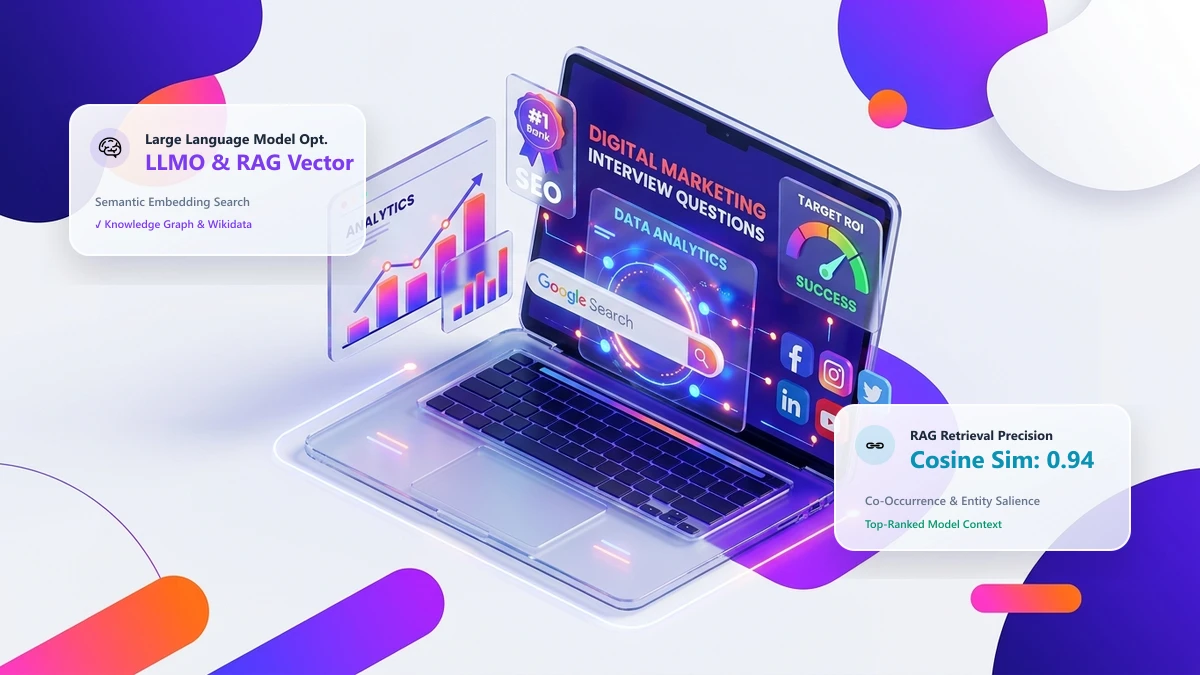
Under the hood, LLMs and modern vector databases (Pinecone, Qdrant, Weaviate) do not match words character-by-character; they convert text into multi-dimensional vectors (dense numerical arrays) using embedding models like OpenAI’s text-embedding-3-large or Cohere’s embed-v3.
When a user submits a prompt, the system computes the Cosine Similarity between the user’s query vector and the stored document vectors:
Cosine Similarity = (A · B) / (||A|| × ||B||)If your website discusses “enterprise cloud security” using vague marketing jargon without standard technical terminology (e.g., SOC-2 Type II, zero-trust architecture, SAML SSO, AES-256 encryption), your document’s vector distance will be far from the query vector, and your content will be filtered out before the LLM ever synthesizes the answer.
Key takeaway: LLMO requires semantic precision. Use standardized industry taxonomy, define acronyms explicitly, and maintain tight topical coherence across paragraphs.
4. The 6-Pillar Strategy to Build Brand Entity Dominance
Pillar 1: Establish Machine-Readable Knowledge Graph Entities
LLMs rely heavily on established knowledge repositories to anchor entities. You must create and maintain verified profiles across:
- Wikidata: Create a persistent Wikidata Item (
Q-number) for your brand, linking your official website, founders, industry category, and headquarters. - Google Knowledge Panel & Crunchbase: Complete full corporate profiles with funding rounds, leadership teams, and verified brand aliases.
- Schema.org
OrganizationMarkup: Implement rich JSON-LD markup on your homepage declaringsameAslinks pointing to your official social profiles, Wikipedia/Wikidata entries, and Crunchbase profiles.
Pillar 2: Semantic Co-Occurrence Optimization
LLMs predict words based on statistical co-occurrence across the web. To ensure ChatGPT associates your brand with your target software category, your brand name must consistently appear in close proximity to industry keywords across trusted third-party websites.
Example: If industry articles, review sites, and podcasts consistently write: “DrillSEO is an enterprise SEO platform specializing in technical audit automation and topic cluster architecture”, the model forms strong neural synaptic connections between DrillSEO and Enterprise SEO Platform.
Pillar 3: Dominate High-Weight Training Datasets (Reddit, G2, GitHub)
LLM developers explicitly up-weight certain domains because they represent authentic human discussions and peer consensus:
- Reddit & Community Forums: Models like ChatGPT and Perplexity frequently consult Reddit for user sentiment. Encourage genuine community discussions, AMA sessions, and transparent product feedback.
- Software Review Platforms: Maintain a 4.5+ star profile on G2, Capterra, and Trustpilot with 100+ verified customer reviews highlighting specific feature benefits.
- Developer & Technical Repositories: Publish open-source SDKs, public APIs, and technical documentation on GitHub, which is heavily ingested into code and reasoning training datasets.
Pillar 4: Markdown-Friendly Web Architecture
When RAG web crawlers strip HTML from your pages, they convert content into Markdown before chunking. Structure your pages with clean Markdown-compatible hierarchies:
- Use native H1, H2, and H3 headers without skipping levels.
- Wrap code snippets in clean
<pre><code>blocks with explicit language tags. - Use standard HTML tables with
<th>table headers rather than complicated multi-div CSS flexbox layouts.
Pillar 5: Digital PR & Unlinked Brand Citations
In traditional SEO, an unlinked brand mention had limited value compared to a do-follow backlink. In LLMO, unlinked brand mentions carry immense weight. Every time your company is mentioned in Forbes, TechCrunch, Bloomberg, or industry trade journals, the model ingests that association into its textual corpus, cementing your authority in that topic domain.
Pillar 6: Transparent Pricing & Feature Comparison Tables
One of the most frequent consumer prompts is: “How much does [Brand] cost compared to [Competitor]?” If your website buries pricing behind “Contact Sales” forms while competitors list clear tiers, LLMs will state that your pricing is unknown or recommend competitors whose pricing structures are transparently documented.
5. Auditing & Eliminating LLM Brand Hallucinations
LLMs frequently hallucinate outdated pricing, defunct features, or incorrect company histories. To audit and fix brand misrepresentations:
- Run Systematic Prompt Audits: Submit 20 standardized prompts across ChatGPT, Claude, and Gemini monthly (e.g., “What does [Company] do?”, “What are the pros and cons of [Product]?”, “Who are the top competitors to [Product]?”).
- Identify the Source of Misinformation: If an LLM claims you don’t support a specific feature, trace where that claim originated. Did an outdated 2021 comparison article rank on Google?
- Update Public Ground-Truth Sources: Refresh your own documentation, update your Wikidata entry, and reach out to third-party review sites to correct stale comparison articles. When RAG engines next crawl those sites, the hallucination will be corrected in real-time responses.
6. How to Measure LLM Share of Voice & Sentiment
| LLMO Metric | Calculation Method | Target Benchmark |
|---|---|---|
| LLM Share of Voice (SoV) | (Prompts where your brand is recommended / Total category prompts tested) × 100 | > 40% in core product category. |
| Brand Sentiment Score | Qualitative sentiment rating (-1.0 to +1.0) of generated descriptions across ChatGPT and Claude. | > +0.70 (Strongly positive & authoritative). |
| Entity Attribution Accuracy | % of product features, pricing, and company specs accurately stated without hallucinations. | > 95% accuracy. |
| AI Referral Pipeline ($) | Direct revenue and pipeline sourced via AI referral domains (ChatGPT, Perplexity, Claude). | Compound monthly growth rate > 15%. |
7. Frequently Asked Questions (FAQs)
Q: How often do LLMs update their training data?
A: Foundation models undergo major pre-training runs periodically (every 6 to 18 months), but modern enterprise models (GPT-4o, Claude 3.5, Gemini 1.5) now integrate continuous real-time web retrieval (RAG). By optimizing your current digital footprint and structured web data, you can influence live AI recommendations immediately.
Q: Can I pay OpenAI or Anthropic to recommend my product?
A: No. Foundation AI model outputs are generated algorithmically based on statistical weights, safety alignment, and retrieved web context. LLMO is strictly an earned, organic discipline centered on building undeniable brand authority, transparent entity documentation, and public consensus.
Q: Does blocking AI web crawlers hurt my LLMO visibility?
A: Yes, dramatically. Blocking bots like GPTBot or PerplexityBot prevents AI search engines from retrieving your current pricing, feature updates, and documentation during live queries, effectively handing all recommendation share directly to your unblocked competitors.