Why Guest Posting Guidelines Matter in 2026
Guest posting remains a powerful strategy for building backlinks, expanding audience reach, and establishing authority in your niche. However, with Google's increasingly sophisticated algorithms and the rise of AI-generated content, the standards for quality guest posts have never been higher.
As a website owner or blog manager, accepting low-quality guest posts can harm your site's reputation, SEO performance, and reader trust. This comprehensive guide outlines 15 essential rules to check before accepting guest posts in 2026, helping you maintain content quality while benefiting from the advantages of guest contributions.
Quick Tip: Create a dedicated "Write for Us" or "Guest Posting Guidelines" page on your website that clearly outlines your expectations and requirements. This saves time by filtering out unsuitable submissions before they reach your inbox.
15 Essential Rules for Accepting Guest Posts
1. Verify the Author's Identity and Expertise
In 2026, with the proliferation of AI-generated content and fake personas, verifying a guest author's identity is more important than ever.
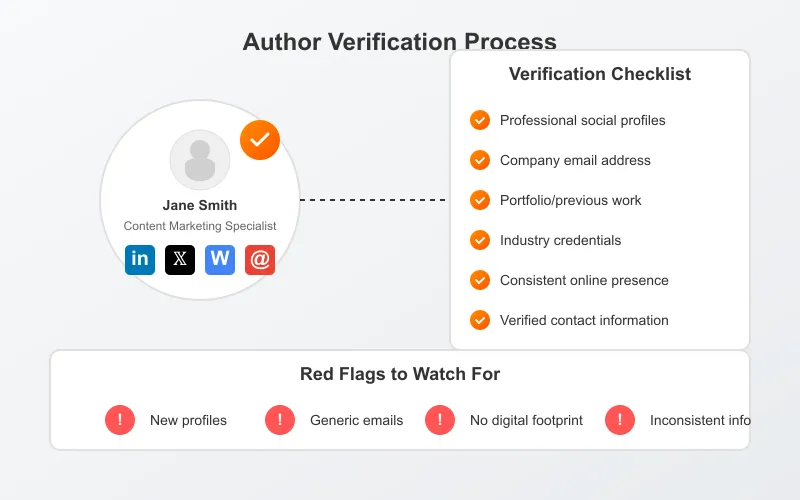
What to check:
- Professional social media profiles (LinkedIn, Twitter, etc.)
- Author's personal or business website
- Previous publications and writing samples
- Industry credentials or certifications
- Email address matching their domain (e.g., name@theircompany.com)
Red flags:
- Recently created social profiles with minimal activity
- Generic email addresses (Gmail, Hotmail, etc.) for "professional" writers
- Inconsistent author information across platforms
- No digital footprint in your industry
2. Assess Content Quality and Originality
High-quality, original content is non-negotiable in 2026. With advanced AI detection tools available, there's no excuse for publishing AI-generated or plagiarized content.
What to check:
- Run the content through plagiarism detection tools like Copyscape, Grammarly, or Originality.ai
- Use AI content detection tools like GPTZero, Content at Scale AI Detector, or Writer.com's AI Content Detector
- Evaluate writing quality, including structure, flow, and readability
- Check for proper grammar, spelling, and punctuation
- Verify that statistics and claims are properly cited with credible sources
Quality standards:
- Content should be 100% original (not published elsewhere)
- Writing should be engaging, clear, and free of fluff
- Information should be accurate and up-to-date
- Content should demonstrate expertise and provide value to readers
3. Ensure Topic Relevance and Alignment
The guest post topic must align with your website's niche and provide value to your audience.
What to check:
- Topic relevance to your website's core themes
- Alignment with your audience's interests and needs
- Uniqueness compared to existing content on your site
- Potential to add new insights or perspectives
Red flags:
- Generic topics with no specific angle
- Topics that feel forced to include certain keywords or links
- Content that's too similar to existing articles on your site
- Topics that don't match your audience's interests or knowledge level
4. Examine Backlink Quality and Relevance
In 2026, Google's link evaluation is more sophisticated than ever. The quality and relevance of backlinks in guest posts are crucial for maintaining your site's SEO health.
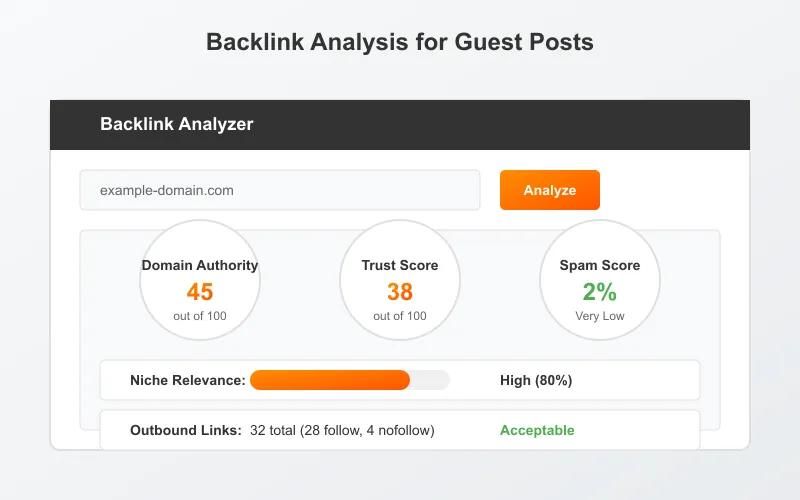
What to check:
- Domain authority of linked websites (using tools like Ahrefs, Moz, or Semrush)
- Relevance of linked sites to your niche
- Contextual appropriateness of the links
- Number of outbound links (should be limited)
- Anchor text naturalness (avoid exact-match keyword anchors)
Link guidelines:
- Limit outbound links to 1-2 per 1,000 words
- No links to competitors, gambling, adult, or other prohibited content
- Links should add value to readers (not just benefit the author)
- Anchor text should be natural and descriptive
- Consider using "nofollow" attributes for commercial links
5. Check for Proper Formatting and Structure
Well-structured content improves readability and user experience, which are important ranking factors in 2026.
What to check:
- Proper use of headings (H2, H3, H4) in a logical hierarchy
- Short, scannable paragraphs (3-4 sentences maximum)
- Use of bullet points and numbered lists where appropriate
- Inclusion of relevant images, charts, or infographics
- Proper formatting of quotes, statistics, and citations
- Appropriate use of bold and italic text for emphasis
Formatting requirements:
- Content should include a compelling introduction and conclusion
- Each section should have a clear purpose and flow logically
- Visual elements should enhance understanding (not just decoration)
- Content should be mobile-friendly and easy to scan
6. Verify Image Rights and Optimization
Proper image usage is essential for avoiding copyright issues and maintaining site performance.
What to check:
- Copyright status of all images (should be properly licensed or original)
- Image attribution where required
- Image optimization for web (appropriate file size and format)
- Alt text for accessibility and SEO
- Relevance of images to the content
Image guidelines:
- Prefer original images or properly licensed stock photos
- Images should be compressed and in modern formats (WebP preferred)
- Include descriptive alt text for all images
- Maintain consistent image dimensions and style with your site
7. Evaluate SEO Elements
In 2026, SEO best practices continue to evolve. Guest posts should follow current optimization standards without over-optimization.
What to check:
- Appropriate keyword usage (primary and secondary keywords)
- Keyword density (should be natural, not forced)
- Meta title and description suggestions
- Internal linking opportunities within your site
- Schema markup suggestions where applicable
SEO guidelines:
- Focus on user intent rather than keyword stuffing
- Include semantic variations of keywords naturally
- Ensure content comprehensively covers the topic
- Aim for content that can rank for featured snippets
8. Review Author Bio and Credentials
Author bios should be professional, relevant, and add credibility to the content.
What to check:
- Relevance of author credentials to the topic
- Professional tone and presentation
- Appropriate length (typically 50-100 words)
- Number and quality of links in the bio
Bio guidelines:
- Limit bio links to 1-2 professional profiles or websites
- Bio should highlight relevant expertise and experience
- Avoid overly promotional language
- Include a professional headshot where appropriate
9. Assess Content Depth and Comprehensiveness
In 2026, Google continues to reward comprehensive, in-depth content that thoroughly addresses user queries.
What to check:
- Word count appropriate for the topic (typically 1,500+ words for comprehensive guides)
- Coverage of all relevant aspects of the topic
- Inclusion of expert insights and unique perspectives
- Anticipation and addressing of reader questions
Content depth guidelines:
- Content should be thorough without unnecessary padding
- Include practical examples, case studies, or data where relevant
- Provide actionable takeaways for readers
- Cover both basic and advanced aspects of the topic where appropriate
10. Check for Commercial Intent and Disclosure
Transparency about commercial relationships is both an ethical requirement and a legal necessity in many jurisdictions.
What to check:
- Presence of promotional content or affiliate links
- Proper disclosure of sponsored content or affiliate relationships
- Balance between informational and promotional content
- Compliance with FTC guidelines and other relevant regulations
Disclosure guidelines:
- Require clear disclosure of any commercial relationships
- Promotional content should be minimal and add value to readers
- Consider using "nofollow" attributes for commercial links
- Reject content that's primarily promotional with little informational value
11. Evaluate Readability and Audience Appropriateness
Content should match your audience's reading level and expectations.
What to check:
- Reading level (using tools like Hemingway Editor or Grammarly)
- Tone and style consistency with your brand
- Use of industry jargon and technical terms
- Cultural sensitivity and inclusivity
Readability guidelines:
- Aim for appropriate reading level (typically 7th-9th grade for general audiences)
- Use clear, concise language
- Define technical terms when necessary
- Maintain a consistent tone that matches your brand voice
12. Review for Factual Accuracy
Factual accuracy is non-negotiable for maintaining credibility and E-E-A-T (Experience, Expertise, Authoritativeness, Trustworthiness).
What to check:
- Accuracy of facts, statistics, and claims
- Currency of information (especially for rapidly changing topics)
- Quality and credibility of sources
- Proper citation of sources
Accuracy guidelines:
- Require citations for statistics and specific claims
- Prefer primary sources over secondary ones
- Verify information from multiple sources when possible
- Be especially careful with health, financial, or legal information
13. Check for Duplicate Content Submissions
Some guest authors submit the same content to multiple sites, which can create duplicate content issues.
What to check:
- Run unique phrases from the content through Google search (in quotes)
- Ask the author directly if the content is being submitted elsewhere
- Check the author's recent publications for similar content
Exclusivity guidelines:
- Clearly state whether you require exclusive content
- Consider asking for a period of exclusivity (e.g., 30 days) before the content can be republished elsewhere
- Require canonical links if content is republished with permission
14. Assess Mobile-Friendliness
With mobile-first indexing fully implemented in 2026, content must be optimized for mobile devices.
What to check:
- Content structure suitability for mobile viewing
- Image sizing and responsiveness
- Table and embedded content mobile compatibility
- Length of paragraphs and sentences (shorter is better for mobile)
Mobile optimization guidelines:
- Keep paragraphs short (1-3 sentences)
- Use descriptive subheadings frequently to break up text
- Ensure tables can be scrolled horizontally on mobile if necessary
- Test how content appears on different screen sizes
15. Implement a Revision Process
Even good content often needs revisions to meet your specific standards.
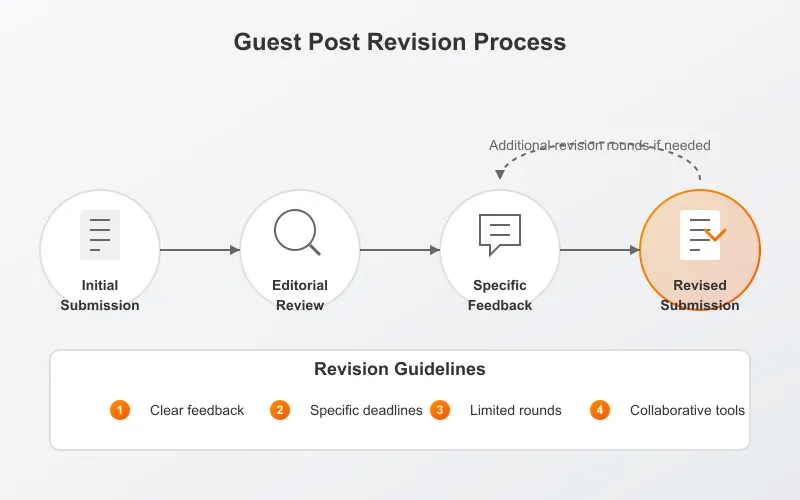
What to establish:
- Clear revision guidelines and expectations
- Number of revision rounds permitted
- Timeline for revisions
- Process for providing feedback
Revision process guidelines:
- Provide specific, actionable feedback
- Set clear deadlines for revisions
- Be willing to reject content that doesn't meet standards after revision attempts
- Consider using a collaborative editing tool for easier revisions
Creating a Guest Posting Policy
Based on the rules above, create a comprehensive guest posting policy for your website. This should be publicly available and include:
- Content quality standards and expectations
- Topic guidelines and preferred subjects
- Formatting and structure requirements
- Link and promotional content policies
- Image requirements and guidelines
- Author bio guidelines
- Submission and review process
- Rights and ownership clarification
Pro Tip: Create a guest post submission form or checklist that authors must complete before submitting content. This ensures they've read your guidelines and helps filter out low-quality submissions.
Benefits of Maintaining High Guest Posting Standards
Implementing strict guest posting guidelines offers numerous benefits:
- Improved Content Quality: Higher standards lead to better content that engages your audience
- Enhanced SEO Performance: Quality content and relevant backlinks improve search rankings
- Stronger Reputation: Your site becomes known for quality, attracting better contributors
- Reduced Editorial Workload: Clear guidelines mean less editing and revision work
- Protection from Google Penalties: Avoiding low-quality guest posts helps prevent algorithmic or manual penalties
- Better User Experience: Readers benefit from consistently high-quality, relevant content
Conclusion
In 2026, guest posting remains a valuable strategy for content diversification and link building, but only when done with strict quality controls. By implementing these 15 essential rules, you can ensure that guest posts enhance rather than detract from your website's value, authority, and search engine performance.
Remember that it's better to publish fewer, high-quality guest posts than to compromise your standards for quantity. Your website's reputation and SEO health depend on maintaining consistent quality across all content, whether created in-house or contributed by guests.
Frequently Asked Questions
How many guest posts should I accept per month?
There's no magic number, but focus on quality over quantity. For most sites, 2-4 high-quality guest posts per month is a sustainable pace that allows for proper vetting and editing without overwhelming your regular content schedule.
Should I charge for guest post publication?
Charging for guest posts (without proper disclosure) violates Google's guidelines against paid links and could result in penalties. Instead, focus on accepting high-quality content that provides value to your audience. If you offer sponsored content opportunities, ensure they're clearly disclosed and use nofollow links.
How can I efficiently screen guest post pitches?
Create a standardized submission form that requires potential contributors to provide their credentials, writing samples, proposed topic with outline, and confirmation that they've read your guidelines. This front-loads the screening process and saves time by filtering out unsuitable pitches.
What's the ideal word count for guest posts in 2026?
The ideal length depends on the topic, but comprehensive content typically requires 1,500-2,500 words to thoroughly cover a subject. Focus on content depth and quality rather than arbitrary word counts. Some topics may require 3,000+ words, while others can be effectively covered in 1,000 words.
How should I handle guest posts that need extensive editing?
If a submission requires extensive editing but has potential, provide specific feedback and ask for revisions rather than doing the work yourself. If the author is unwilling or unable to make necessary improvements, it's better to reject the submission than invest excessive time in editing.